How to Stay Connected With Adult Children in a Digital World — With Nathan Graham
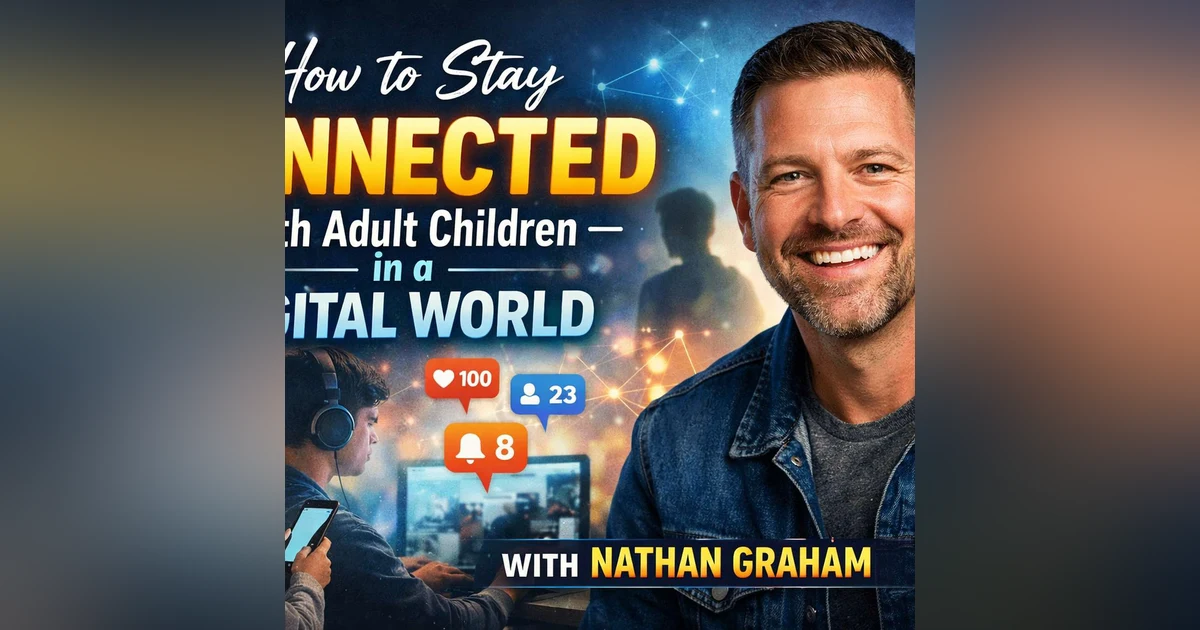
Click on Fan Mail link and give me feedback. Thanks Navigating Parenthood and Adult Relationships: Insights on Connection, Needs, and Digital Influence In this episode, James Moffitt and guest Nathan Graham explore the complex journey of staying connected with adult children, the underlying needs driving behaviors like gaming and social media use, and practical strategies for healthy boundaries. Main Topics: The core human needs: certainty, adventure, significance, and love connectionHow mode...


Click on Fan Mail link and give me feedback. Thanks
Navigating Parenthood and Adult Relationships: Insights on Connection, Needs, and Digital Influence
In this episode, James Moffitt and guest Nathan Graham explore the complex journey of staying connected with adult children, the underlying needs driving behaviors like gaming and social media use, and practical strategies for healthy boundaries.
Main Topics:
- The core human needs: certainty, adventure, significance, and love connection
- How modern society and technology affect the fulfillment of these needs in young adults
- The impact of social media and gaming on emotional health and behavior
- Techniques for parents to foster understanding and set effective boundaries
- The importance of curiosity, grace, and relationship-building in parenting
In this episode:
- Nathan explains how unmet needs can lead to addictive and withdrawn behaviors
- The challenges of participation trophies and changing educational dynamics
- The role of dopamine and social media algorithms in addiction cycles
- Practical tips for establishing device boundaries with children and teens
- The "three deep questions" approach to understand root causes behind behaviors
- The importance of emotional safety, validation, and shared purpose in parent-child relationships
Timestamps:
Richard Jones. I am an RN with over 34 years of Nursing Experience, much of that experience working with young adults in the corrections system.
Parenting Adult Children Call To Action
Social Media Links
https://www.youtube.com/@abcparentingadultchildren
https://www.instagram.com/parentingadultchildren125/
https://www.tiktok.com/@chiefpropellerhead
ABC's of Parenting Adult Children Facebook Page
https://www.facebook.com/profile.php?id=61581576308055
r/parentingadultchildren
Feel free to subscribe to these channels and share the links with your social media portals.
There comes a moment in every parent's life when the role they've known for years begins to change. The children they once carried, guided, and protected become adults. And suddenly the questions become different. How do you stay connected without holding on too tightly? How do you continue loving well when relationships become complicated? And while every family is different, no parent should have to navigate these questions alone. Each week, James Moppet brings together experts and parents who have walked this road before to explore the realities of parenting adult children. Through honest conversation and practical wisdom, listeners find hope for the journey ahead. Whether your relationship is thriving, strained, or somewhere in between, there is hope, there is healing, and there is always the possibility of a stronger connection. ABCs of Parenting Adult Children. Helping parents navigate loving their adult sons and daughters well.
SPEAKER_02Hello and welcome to ABCs of Parenting Adult Children Podcast. My name is James Moffitt, and I will be your host. Today I'm talking with Nathan Graham about the real, faith-shaped journey of staying connected to our kids as they grow into adulthood. Nathan brings wisdom, honesty, and hope to this conversation, and I'm grateful to have him with us. Let's jump in. Hey Nathan, how are you doing, sir? Not too bad, James. How are you today? I'm great. I'm glad to have you on the show. Happy to be here. Yeah, do me a favor and introduce yourself to the listening audience.
SPEAKER_03Yeah, for sure. So as you said, my name is Nathan Graham. I'm a father, an author. My daughter's seven right now, an uncle. So that's my kid experience right now, uncle of many uh young adults and young boys. Yeah, I don't want to say I run an AI company. That's that's kind of what I do now. I was in real estate for 16 years. I run an AI company. I've always enjoyed coaching, learning, psychology. And that's kind of what led me down a lot of this path that I'm going down is a lot of the courses I took around uh personality development, personality uh showcases, um basically trying to understand why we tick and why we do it and do the things that we do. Very good. Where where do you live? So I'm in I'm near Toronto, Ontario, in Canada. Okay.
SPEAKER_01Yeah.
SPEAKER_02I visited uh Bonneyville, Alberta, Canada about 20 years ago, I think. I bet you it's changed a little bit since then. Yeah. Oh yeah. Yeah. Podcasting was not even in on my radar.
SPEAKER_03No, I'm thinking 20 years ago. I don't even think I think I was just getting introduced to the internet 20 years ago. Is that right? Well, I guess maybe it was about 30 years ago, but yeah, I don't even think social media was a thing 20 years ago that I'm thinking about it.
SPEAKER_02Right. Yeah, I graduated high school in May of 1980, and the PC was just coming out. I think sometime in 80, 82.
SPEAKER_01But anyway. One of those old school Commodore 64s. Oh yeah. Yeah, absolutely. So are you married? I am married, yes.
SPEAKER_03Married 19 years this year. I guess I better get that right. All right. 19 years this year, yeah. 2007, September 22nd. And and do y'all have children? Yep, just the one. Uh one daughter, Jordan. So she's six, going on seven this month, about to go on 14 most days, it feels like.
SPEAKER_01Awesome.
SPEAKER_02So, Nathan, your book, Why Won't He Just Log Off, explores the deeper needs behind video game addiction. How do those same underlying needs show up in the lives of adult children who may be withdrawn, disconnected, or struggling?
SPEAKER_03So I think it's always good to kind of review the needs that a lot of us strive for. There's four big main needs that I guess everything we do and everything that we try to do always tries to fulfill, right? So the first one is certainty, that we're always looking for a point of certainty in life. We're looking for a house over our head, food on the table, things like that, right? My spouse is going to be here when I get home. That that's a good point of certainty. The second one that we look for is an adventure. This is what that spice of life, why we do something a little bit different all the time. The third premise is we look at significance, like what makes a person significant. What I need to be respected, I need to be noticed. How am I making an impact on this world? How am I significant? And the last one is loving connection. And that's what he's looking at, the relationships that I build around me and everything else. And everything that we do, if we dig deep enough, will try to fulfill this. Like, for example, James, you and I talking about this, writing the book, everything like that. For me, it's to do things like fulfill my form of significance. It fulfills my loving connection, my ability to give back to people and things like that. And I think right now there's a big disconnect, especially among young adult children, where those needs are no longer fulfilled in the ways that they once were. Right. So you just mentioned that you were in school in the 80s, I was in school in the 90s, is when I graduated high school. We we didn't have a video game world that would fulfill those needs. Instead, we had things like I grew up in Alberta, and we had things like going outside, playing with friends, bush parties, all the rest that would naturally fulfill it. And in today's world, that seems to be it's no longer the same. So, for example, participation trophies within a school system that awards everything equally, right? It's it stops us from gauging our significance through a reward-based system or through hard work or through merit if everything gets awarded equally. And that's one thing that we're beginning to see as uh a void in young adults. That's kind of a long way to answer that, I guess.
SPEAKER_02No, that's okay. Yeah. So, yeah, participation trophies, that is it makes my head spin. I'm like, what? No, no, the game of life includes winners and losers. Not everybody's going to be a winner. And and why do people win? Because they excel at something. Why do people lose? Because they don't excel at something. And that's what drives us to do better, I would think, right? So, yeah.
SPEAKER_03No, it's uh like with that, it almost seems to get worse. Like I know here in Canada we now have the pass them forward program in our school system where it really doesn't matter what their grades are, they're getting bumped up to the next grade. Right? Yeah. It happens here. Yeah. It's so it's it's kind of crazy. Like I myself, if if I'm trying to dictate, am I doing well in life? Because there's no scoreboard that we can check, right? So if I'm trying to figure out am I doing well in life, am I not doing well, do people like me, do they dislike me, there's really no way to judge that anymore.
SPEAKER_02Well, when I was going to school, if you didn't, if you didn't pass the test, and you didn't make you didn't make a passing grade at the end of the semester or whatever, the end of the year, uh, guess what? They held you back until you got it. And and we learned the basics reading, writing, and arithmetic, reading comprehension. Our teachers taught us those basics, and they did a good job at it.
SPEAKER_03And it's, I guess to a degree, I understand the premise of why one might do it. Like having a daughter now, I don't ever want to see her fail. I remember I was watching a uh watching her and uh compete against something against older kids, and she didn't win. And I remember how heartbroken she was that she didn't win, and I wanted to rush in there and get a reward anyway. So I understand the emotional attraction to wanting to do it. The reality is though, how is that preparing her for the job she didn't get? Or is how is that preparing her for the type that she doesn't get a place or a property or breaks up with her verse boyfriend, things like that, right? It doesn't. We're just saving, and and this is home, this is a safe environment for her. Right. And and I think on the on the love and connection side, this one's also kind of very skewed out because we live in a world where I find we live in a world where generally we're telling many women you don't need men in your life, that you're strong, you're independent. And they're women are strong and women are independent, yet we're designed to be partners and we're designed to rely on each other. I can tell you that with my wife and I, anyways. And a lot of men are basically being told that you're from a very young age, your initial drives are not healthy. Like your natural way of responses are not healthy. And so, right from a very young age, we're we're basically being isolated unto ourselves, right? And told that that's the way it should be. And and I think somewhere deep down we realize that's not the way it should be. We should be partners and helping each other out, right?
SPEAKER_02Well, I think society in general, and you know, here in America, the culture drives a lot of that. And then you've got this toxic ma masculinity, you've got feminism, you have all these, you know, uh Me Too movement and all these different movements that have, you know, come through the years, the decades, and and it's like it's like society is trying to rewrite the blueprint of life, you know. I think everybody has a right to be healthy and happy, right? And so I, you know, you know, our world's just uh turned upside down in a lot of ways.
SPEAKER_03Absolutely. And unfortunately, when we start losing these needs, these things that are so key to us, we're gonna fulfill them, whether it's in a positive or a negative way, right? Like if you talk about significance, I have a few ways I can fulfill that. Unfortunately, there's some negative ways. If I want to go be a bully, if I want to down talk and belittle people, well, that'll make me feel pretty good about myself. I'll feel strong and mighty and respected by those around me. But it's a very unhealthy and a very fleeting way of feeling that. Where I played football as a kid in high school. And if you want to talk about significance, man, there's nothing that makes you feel better than when your coach calls your number, you catch a touchdown 50 yards downfield, and all the trust your team puts around you, that's also another way to feel significance. And I'm finding a lot of young people and a lot of young adults, they're trying to find this counterfeit dopamine hit of significance in their lives, whether it be video games, whether it be social media, whether it be dare we trudge into it, but whether it be pornography, whether it be whatever case may be, there's this hole missing, and they're just trying to fill it, right? In very unhealthy ways. And gaming's no different. Like gaming, I think, can have a lot of positive impact on people and a lot of positive things out of it, much like many things, yet it's a great way of wrongfully fulfilling those needs as well. And they're designed to.
SPEAKER_02Well, you talk about dopamine hits. I mean, that's a that's a chemical reaction in the brain. You know, and we we get addicted to that. You know, there's dopamine addictions out there, and it's not just gaming, it's a lot of things. It's technology, you know, podcasting, video games, you know, first-person shooters, racing games, all of the all of that stuff that that gives us that dopamine hit.
SPEAKER_03And I feel like at one point there was always a way of earning that dopamine hit. And I think that's one of the differences now. Like I do know that a dopamine hit can come as little as giving my daughter a hug, you get this little jolta of dopamine, but I still have to earn this relationship with my daughter, right? Or if I get uh a dopamine hit from doing something really well or mastering something, it comes from learning it. It's it's an achievement, not something given for granted. And now there's a lot of things that just they just give it to you. Like here's something visual, especially for a young man. We're gonna create dopamine, and then that's it, you're just gonna enjoy it. And so there's really no effort put into getting that hit anymore, which becomes highly addictive.
SPEAKER_02Right. So let's talk about social media and let's talk about the psychology behind Facebook and TikTok and Snapchat and Instagram and all these social media platforms out there. How do they get how do they get people to stay connected? Right? And I I'm not an expert at it, but I know because I've I've watched many, or not many, I've watched several documentaries where people from those platforms uh do a documentary and talk about the psychology behind keeping people attracted to their screens.
SPEAKER_03So I c coming from the premise, because I this is obvious that's a very, very large conversation, but coming from the premise that I'm building off of with fulfilling needs, uh I don't know if I'd go as far as saying, and it could very well could be that it's systematic and on purpose. Yet when you look at the breakdown of family dynamics, when you look down at the breakdown of relationships uh and family structures, Instagram or Facebook is a great way or TikTok is a great way to start fulfilling that as well. So for example, if I don't if I want to be accepted into a community, but let's say I believe in a flat earth, just as an example, right? So I remember hearing a story once upon a time that if you believed in a flat earth and you're in a town of 10,000 people, there might be the other kid, Jimmy, who believes you, and you and him get together from time to time and talk about your theories, and that's that, right? And so social reality would eventually take away some of those ideas. Now, the part of the problem is that I can go on Facebook and join a community and now run into a thousand people who have the same thought side, right? Well, now it's no longer just a one or two off. We're we're getting reinforced at a very large level, right? Young, young women, my my heart literally bleeds for them for this. Like they they have this the contradiction that they live in. They're told that they should just be happy and satisfied exactly the way they are, and they don't need anybody or anything to make their lives better. Which for some reason leaves them empty because I do believe back into companionship. And then they're told the way to solve that emptiness is here is a bunch of junk that you can buy, put on your face, and make yourself look better. When really all you're trying to do is either get more Instagram likes, and the only people who ever got upset with you not looking a certain way were other women. Like they're definitely not doing it for guys. I I can't speak much to you, James, but I can tell you there's not a very high bar necessarily for me to find somebody just absolutely attractive. Like I am a guy. Like it's I've never once sat there and been like, oh man, my wife isn't wearing blush today. I don't think I can go in public with her. Right? It just doesn't happen. Yet women get criticized for the makeup they wear by other women all the time. And and so we're we're kind of stuck in this infinite loop. And if you think, if if I have no way to fulfill this need to feel normal, I'm gonna go to exactly what it is. And then we have social media, which is very good at detecting what your need is by what you search, by what you're looking up. It detects your fears, and then it builds an algorithm around giving you the dopamine hits to beat those fears. We'll show you the more beautiful women of what you could be if you had a blank, right?
SPEAKER_01And start playing the comparison game. Right.
SPEAKER_02Well, I I think social media is just like anything else in life. It's a tool and it can be used for the good or it can use for bad. And I think when par as parents are listening to this, number one, I think a lot of kids, we're let's talk preteens, teenagers, young adults, uh, they are they were they were born with a smartphone in their hand almost. And they they have smartphones, they have tablets, they have laptops, and they spend a lot of time using those devices. And so they are naturally attracted to them, and there are so many things on there to keep them entertained. And and obviously we've got Google Chat, you've got Chat GBT, you got AI, got 15 different versions of AI that has been built out there, Microsoft Copilot, Claude, blah, blah, blah. Right? So there's a a wealth of information at your fingertips, and there's nothing wrong with that. There's nothing wrong with having access to to knowledge and information, and I think that's great. When I was growing up, we had the the World Book Britannica. That was our information. Or if our parents took us to a local library, you know, I didn't I didn't have information on tap like like kids today. And and yes, the you know, this is actually absolutely a lot lot larger conversation, which is probably a little bit out of scope for our conversation today. So I'll quit running down rabbit holes and and move.
SPEAKER_03Well, it's funny, I don't I don't actually fully mind the rabbit hole because I think you're bringing up some some serious points. Like I I've been I've been thinking a lot about AI lately and a lot of the stories that are coming out of Chat GPT and Gemini and the way people connect and relate with them. And I agree with you, these are tools. I use AI on a on an hourly basis almost. It is very integrated in my life, and it is a tool that helps me succeed and get from point A to B. Yet this will sound weird. If you don't think about the consequences of things like morality and philosophy, it's going to be hard to control AI. And here's what I mean by that. So I what in Chat GPT, you can create rules that it always remembers. It dawned on me one day that I actually had to give my chat GPT a code of ethics. Because there's a moral debate, and I'm on the side that our morality is given to us, it's not learned, right? That as human beings, we don't learn it. Yet there's a big lot of people who think morality is learned and not given. And if morality is individual, that is a big can of worms versus morality being external, right? So you talked about faith-based, my my morality comes from the Bible. That that's the moral code I follow, right? It is external out from me. Well, Chat GPT doesn't know that. And so when I'm asking it for advice or for information, one thing I'm encouraging people is build in the morality that you're expecting to get out of it. Right? Otherwise, you don't like. I built one with the moral with a Christian morality, and it has very different answers on divorce and on whether I should leave my partner than the one that just stalked ChatGPT, right? That's interesting. Yeah. I I think it's good conversation because it's it's something that I'm finding I haven't heard many talk about it from that angle yet.
SPEAKER_02I think parents need to be cognizant of their preteens and teenagers and how much time they spend on on their devices, on their smart device, screen time. How much time are they spending? You know, and I think it's I think it's up to us as parents to to coax our children and to more specifically create boundaries for our children to go, okay, you're going to bed at nine o'clock, your screens are turned off. Right? You trust them. You you extend trust to them and say, okay, when you go to bed, I don't want you to be in bed with your tablet or your smartphone on TikTok or Facebook or whatever, right? And then you and you check on them, you know, from time to time. And if you see light under the door and you know that they're not not following that boundary, then well, then maybe you have to take the smart devices away from them and say, okay, now you're gonna leave the devices in a box, you know, down here on the kitchen table, and you're gonna go to bed. You know, hopefully you don't have to do that, but if you have to as a parent, then you have to, right?
SPEAKER_03Well, and sorry, I if it's okay, I just want to jump in there real quick because I generally I agree with the premise for sure on boundaries. One of the big things though I do see between parents and and young people, and I I'm gonna go back more to the gaming world just because that's the one I'm more intimately familiar with. I do a lot of social media, but I don't I I haven't had the social media addiction, but I one time had the gaming addiction, right? So so let's say we we buy into this idea that that they're using this gaming to fulfill their needs, right? Well, a lot of times parents see it as a form of entertainment, the same way we would see TV, right? And on CV, you can just kind of shut it off, they can go start the program up the next day. I know when I was very hooked and addicted to gaming myself, it was a lot more than that. There was a lot of times I was doing something with five other friends that I would meet online pretty much every day. And so if someone just unplugged that computer, not only did I fail, but those five other people failed. And then I had to somehow go back the next day and convince them that it wasn't me, that it was my parents who did it. Right. And then the conversations they're having is well, is he reliable? Is he a part of the team? Right. And then that further conversation is look, well, what's what's the damage that we're doing in here? And this is a point of encouragement I I really want to give parents. I'm definitely not saying you don't get rid of boundaries, and I love that you bring that up. Because I do believe that they have to have start times, they have to have end times, you have to have bed times, you have to eat healthy. These are all a part of staying healthy. Yet when your son or daughter is getting into something, this could be more than games, but it's getting into something at a level that is fulfilling these needs to tear it away can cause a lot, like a lot of times that causes the bigger rift without two parties really understanding what's happening. Right. And my encouragement to a lot of parents is so for example, uh, the things that I would use to do might take a half an hour. So if I if we made an agreement to be off by 10, give me a 9.30 warning, right? Instead of just coming in at 10 and say off, that warning goes ahead of time to be able to help me settle down what I need to do. We've done this with my daughter, not on video games, just on getting ready to go out. We give her now 10 minute warnings, and it has created and stopped a lot of fights just by giving that warning to allow them to unwind, to finish what they're doing, complete the project in their mind, right? So I definitely want to say I agree with you, and I do think that at times you do take it away. Although at one point, I definitely want to encourage parents to also look a little bit deeper. Into what might be happening. Does that make sense? Yeah, absolutely.
SPEAKER_02Well, and I think that I think our I think our children, uh young adults, are somewhat at a disadvantage because of the technology is at their fingertips, right? So so we can't we just need to be aware of that. We need to be aware of the danger of of them becoming addicted for the wrong reasons. You know? Absolutely. And I also think that while you're setting boundaries, you don't have to be a jerk about it. You know, I absolutely don't think dad should walk into somebody's some kid's bedroom and just unplug the computer because he gets mad that they're still on they're still online. You know, there's you can it's not what you say, it's like how you say it. Right? It's not what you and and so I think parents need to finesse how they're communicating with their young people, right? And so you walk in and you say, Okay, John, you know, I asked you to go to bed at 10 o'clock and turn off your devices and you're still on your computer. So I'm gonna give you an extra 10 minutes to wrap up what you're doing, end your game, find us find a stopping point.
SPEAKER_03Well, I I I love that part of what you're saying too, because the eventually you do have consequences. So something that I do talk about and we do with my daughter quite a bit. And again, my daughter's younger, so she's not in her teen years yet. Yet we give her consequences to her actions. And it doesn't matter if we're mad or not mad, we fulfill those consequences. So we started this thing, for example, she really wanted cuddle time at bedtime, and we were for the longest time, we were kind of against bedtime cuddles, right? She started acting out, so we introduced five minutes of bedtime cuddles. But then she started coming out of her room again, right? And so the consequence was, honey, if you come out of your room tomorrow night, you do not get cuddles. She would come out again. And sure enough, the next night, she just wouldn't get cuddles. We weren't mad, we weren't upset. This was just a consequence of your actions, right? And I think there's a big difference to the point that you're making between going in and just ripping it out of the wall and saying, 10 more minutes, and this is what's going to happen. So you're giving them a choice. You you have a choice that you can finish this up, or I'm going to come unplug it. But at least they're aware of the choice, right?
SPEAKER_02Amen. So, Nathan, you encourage parents to ask, what need is this behavior meeting? Can you unpack how that question changes the way parents understand an adult child's gaming, avoidance, isolation, or addiction patterns. I know you've talked a little about some of those.
SPEAKER_03So I always think the best way, I love what's called the three deep questions. And if it's okay, James, I'll role-play them with you because for fun, because we get to do it so parents and you can see how it works, and parents can see how it works. So the three deep questions is when you ask, uh it was actually a real estate thing I learned this in. You ask the first question, and you're gonna give me the answer that I think that you think you want you want, that you think it is. Then I'm gonna ask the question again, and you're gonna give me the answer you think I want to hear. And then the third time I'm gonna ask the question will typically be the truth behind the real answer, right? So ready for this? So if I ask you, James, why why did you start these podcasts?
SPEAKER_02Well, because it's fun, because it meets well, the parenting adult children is is for support of parents of adult children. Awesome.
SPEAKER_03So it's fun and you like to support adult or parents of adult children. That makes sense. So let me ask you, as you're having some fun in life and as you as you're making this support, how does that affect you day to day, knowing that you're accomplishing this goal?
SPEAKER_02Well, it gives me a certain sense of satisfaction and it gives me uh purpose.
SPEAKER_03Awesome. So now you're walking every day with some satisfaction and some purpose. And and the final question I would have, uh James, is when you have this satisfaction and this purpose going on in your life, how does that positively affect the aspects of your life?
SPEAKER_02Well, it it may it makes me feel good, you know, it makes me gives me validation. Awesome.
SPEAKER_03Okay. So here, as a quick little role play, and I always love doing it when it's just random, if I were to stop at the very beginning, it's like, it's fun, and I like to help people. That that's where the conversation would have ended. But by the time we're done asking three simple or asking the question two more times, I find out actually, not only are you meeting a need of a validation and connection, this is also your way of giving back to the people around you. This is actually more than fun. What did you say? Purpose. To give for this to give you a purpose in life and fulfillment, that that's a pretty big major thing that this is filling for you, right? And so by going three deep, I begin to understand the core of why you do this. Where if I were to stop at the first question, then who really knows what just having fun is? That that's a very subjective term, right? And and this is what I encourage with parents is go the three deep with your kids. Why, why do you play this game? I I love to I love to kill the bad guys, right? And you're like, oh, well, when you do that, how does that make you feel? Oh, it makes me feel great. It makes me feel like I'm a hero. Fantastic. When you feel like a hero, how does that change your day-to-day life? It gives me confidence for the next day, right? Or insert whatever here. That is a very different conversation than quit playing the game. You're you're now seeing that there's this strive for confidence, that there's this strive of belonging in in your child's life that they're trying to fulfill. And this is the core of them doing it. The same way I once used football for doing that, right? The same way that this is purpose and fulfillment in a podcast. And that's where the encouragement comes into play to dig deeper into what their goals look like and what they're trying to do. That's very good. I like that. As a side note, by the way, they often don't even know either. It's funny, even with adults that do these sort of things, it's not exactly a common conversation that we think about. It's we we don't think about, I don't know in the last time. Maybe you have, maybe you're in depth. I don't know. But uh, I know I know this stuff, and I don't think about how writing this book is going to positively impact my life on a day-to-day basis. I just did it because it had some surface need that I wanted to fulfill. It had a message I wanted to share, but really, if you get dig down, it goes a lot deeper than that.
SPEAKER_02Right. So many parents feel confused or even hurt when an adult child pulls away emotionally. From your experience, what might be happening beneath the surface that parents don't often see?
SPEAKER_03So this one might be I I could be challenged on this one, um, but I I would welcome the challenge. When I look at childhood development into the teenage years, and I look at children trying to fulfill these needs within them, a lot of it comes from the parent. A lot of their safety, their security, their adventure, their significance, their loving connection comes from their parent. At about 12, 13, 14 years old, something seems to change. No longer are the parents the main focus in the child's life. I remember, I remember reading a study one time saying a teenager and a two-year-old have the exact same pushing boundaries in common. It's just who they look for for the answer of those boundaries is different, right? So a two-year-old pushes these boundaries to learn what's going on in the house, and the teenager is pushing the boundaries of the world and what's going on there. And there's a shift. Number one, I think it it's hard for parents when that teenager shifts from being your best friend to now being an adult and learning how to be an adult in the world. They just turned 13 years old, they're feeling complex emotions for the first time. They're trying to figure out and navigate what goes on here. They now already think they're much smarter than you as a parent because they've learned a whole bunch of stuff in books, right? And really what they're trying to do is navigate into this world. And for a parent, they're no longer the navigator. They're no longer the source, they're no longer the compass. They're looking to teachers, they're looking to friends. Where a shift for the parents can be, we switch from the navigator to the guide. We've been there before. We we've been through heartbreak. We've been through these complex emotions. They're not experienced, we're not experiencing for the first time. Yet, I don't know about you, James. I've been racking my brain since I thought about this for just one example of a time my father looked at me, told me something, and I just listened to him. It doesn't happen.
unknownRight?
SPEAKER_03Like my father wasn't like, don't go out drinking with your friends. I'll be like, I'm gonna go drink and be stupid, and I'll learn the hard way, right? That's what a lot of teenagers are about. So, really, what's the approach? Is the father gonna try to stop that? Because it's not going to work. Or can we help guide it through them as it does work? Help create the safety and the boundaries at the home level as they go and explore this world. And by doing so, you're still helping fulfill those needs in your child. You're just helping them become strong and independent. And that's a hard thing to do. That's a hard thing to do at all ages, sure. Let alone in these days where we don't think 13-year-olds are capable, but they're probably far more capable than we give them credit for.
SPEAKER_02I remember when I was a young man, I thought my parents were I thought they were out of touch, and I thought they had no clue what was going on. I thought they were old and just out of touch. And between the ages of, I don't know, 17 to about 25 or 26, I was a train wreck or a dumpster fire. And one day I had an epiphany that my parents weren't as stupid as I thought they were. And I I was in Houston, Texas, and I got on a payphone. For those of you that don't know what a payphone is, it's this black box that sits in a glass-in encasement that you walk up to and you put a quarter in it and you dial a number. And you have to know the number or you can't make the phone call. Anyway, I called my parents, and we were not on good speaking terms when I did this. And it was I had to eat a lot of umble pie to do this, but I called and my my dad answered. You know, I said, Hey dad. I said, I just I wanted to let you know I'm okay, and I wanted to let you know that I have come to the conclusion that you guys have a lot of wisdom and you knew what you were talking about. And it was something to that effect. That's not word for word, but you know, I I admitted that I was wrong, that they were right, and that uh, you know, I appreciated their wisdom, and there are a lot of things that that well one of the things my dad used to tell me is he said, if things are worth doing, they're worth doing right the first time. You know? And that's that has stuck with me through the years. And another thing he told me was was that uh he says, think about what you are gonna do before you do it. Think about it. And the reason for that is because there's consequences to our decisions. Sometimes those consequences, they're minor, of no consequence, and then sometimes they can be they can last you a lifetime. They can be very that consequence can be severe, right? Like going out and drinking and wrapping a you know, having a head-on collision with a family of four and killing half of them or more all of them. You know, that's a great, great example of of not thinking about what you're doing when you go out and you you drink and get into a 2,000-pound vehicle and drive down the road.
SPEAKER_03Well, you're you're not wrong in that because as you're speaking, really what's coming to mind is this is what's so beautiful about allowing someone at 13, 14, 15 years old to be making mistakes and not sheltering them or putting so many rules that they can't go make those mistakes. Because you hope, similarly for me, I was about 23, 24 when I had to have that conversation with my parents. You hope that they start to learn those lessons a bit faster, right? I remember I remember hearing a difference between knowledge and participatory knowledge. And if you like, you take a chair, both you and I know how a chair is. Like we know what it is. We know it has four legs, we know it has a back and a seat. But if you and I were to ever sit down with a chairmaker, we'd probably learn more about a chair than we than he like we would ever forget. Like he understands, the chairmaker understands the balance, the wood, the feeling, the designs. Like a chairmaker intimately knows this chair because it participated in the creation of it, right? We as teenagers have the book knowledge. Our parents have the participatory knowledge, right? And and that's what the teenager is lacking is that that that participatory knowledge. And that's what our point is to help them gain. They they know driving drunk is stupid. Sure. But maybe they need to go get drunk before they can drive to figure out how stupid it really is. So maybe they're like, wow, man, I couldn't even roller blade while after a few drinks, or I could barely walk straight, let alone drive. Right. Right? Maybe that's the soft way they learn before they learn the hard way. They're participating in the action to figure out why it's a bad action before it gets too serious.
SPEAKER_02Right. And that's why it's so important that parents have a good relationship with their children and to provide a safe space and a place where the children feel loved and welcomed and they need validation, they need to know they have purpose in this life, that they're people of value, and that they can they can bring value to the world around them. And so if you do all of that, and we parents definitely try to do that in our own way, we've we stumble, we fall, we make mistakes, but if you can manage to have a good enough relationship with your preteen, your teenager, your young adult, if you start at some point, if you realize, ooh, I'm not doing this, start now, start today, apologize, do whatever you need to do to get that relationship straight because you want that young adult to feel safe to call you on the phone and go, you know, I did something today, or I'm having this situation and I want to share it with you. And they're not calling you so that you can fix the problem, but they you want them to be able to feel safe to share that experience with you, and then maybe at some point during that conversation, they might ask you, what do you think, or what did you experience as you when you were my age, or ask you for that participatory whatever you said. What was that? Participatory knowledge. Yeah, yeah, that, that. So, so yeah, it's it's you know, and I like how you broke that down. And I I don't even think I've ever even heard that. I under I understood that in a different way. Right.
SPEAKER_03And and I want to I think you're touching on something very important too, because I really want to encourage parents that are out there. It's very easy for you and I to sit here and after research, and my kid is right now not in the room. I can sound like this great dad, and I I can know all these things. Man, parenting is hard and it can suck sometimes. It is a very it is very lonely. I was speaking with a guy earlier today who started a dad's group. You know, one of the things about dads, and I can't speak, I've never been a mom, but I've been a dad. One of the things about mom's groups is you could throw a stone and hit 15 support groups. I'm not saying they're good, but you could find them. That's a lot harder to do with dads. And our role is massively shifting. It's a very, it can be a very lonely job. And my goal is not actually to do all these things in my book or to practice these things every single day. My goal is literally just to implement one thing today that I didn't do yesterday. And know that when I fail, I hopefully fail with grace and love and compassion. I can forgive myself and be better the next day. Right? Like parenting is definitely if you're chasing perfection, that's just chasing anxiety. Allow yourself to fail. You are definitely not alone. You are not a bad parent. Your kid's alive. I remember that's what someone once told me. That's the benchmark. If your kid's still alive the next day, you did a pretty good job.
SPEAKER_01Right. Right.
SPEAKER_02That's exactly right. So you talk about escape, control, identity, and emotional safety as drivers of addictive or numbing behaviors. How can parents begin recognizing which of these needs their adult child might be seeking?
SPEAKER_03So I think we start when we start to see certain behavior, this gets out of the branch of this can be a positive thing or it's just an escape, that we're getting into a branch now that is becoming an addiction or it's becoming a way of checking out from the world. And it's really signs that you would see in most things like depression and all the rest. If you find that your once very social kid gets a new game and they play it for a week, probably not a warning sign. But if they're playing it a month later, probably start to pay attention if they're playing it at the same level. If they start to disconnect from their friends, if they're starting to disconnect from their families, these are all signs that this is now probably going something deeper. They're probably getting unhealthy needs met. I would argue this is the same that if you saw a friend who was just maybe never a social drinker, and all of a sudden you see them start to drink more and more and more, you see a lot of the same signs. Uh gambling addicts, you'll see a lot of the same signs. You actually see the signs of addiction as they start to fall down, right? So a point of encouragement is pay attention. If you start to see the signs of depression, it's probably going to a place of depression. And don't be afraid to ask for help. I I get confused that people have a hard time asking for therapists or life coaches or things like that. And life coaching, I my my wife and I took life coaching. It was one of the best things we could have ever done. Like we we don't always know what's going on. Even as adults, we don't always know what's going on inside of us. And it just helps to have somebody guide us to figure it out. That's all it is. Right. So don't be afraid to ask for help at all.
SPEAKER_02Parents often wrestle with a tension between staying connected and not enabling unhealthy patterns. What guidance would you give them for finding that balance?
SPEAKER_03Set rules together. There's something that we started touching on. We didn't really dive deep into it. Yet set rules together. So don't arbitrarily as a parent just tell them this is the time it turns off. Talk with them about it. Let them know the responsibilities. Your responsibility is still school. You have to be awake for it. You still have to get your homework done. Right? So, what does how does your gaming, if you want a game, instead of us just rejecting it, if you want a game, how does it fit into this, right? Set the responsibilities. Take some time and learn. If you ever get an opportunity to learn about professional gamers, and yes, that is actually a real thing. People make money through professional gaming. It is absolutely phenomenal what they do. They fully understand the need for breaks. They understand they cannot be in front of the screen for uh 12 to 16 hours. They understand the need to eat healthy, to get into shape. They understand the need to research off the screen. They understand the need for goal setting and leadership. These are all amazing skills that you can pick up from a game when you begin to understand it and start treating the game properly, right? So encourage. If I met one boy, one young man, call him a boy. I shouldn't have called him a boy. One young man, he was about 17, 18 years old. He got so mad every time he played with people and he died before all of them, and he blamed his team and he was just angry about it. And you could tell the next day he was seething over it. And I eventually just looked at him and I was like, dude, what could have you done though to avoid that situation? When you're on a bad team, what can you do to change this? And I started challenging the mindset with him because I was hoping, and I believe for a while it did, it shifted him from being a victim in this to now being a player in it. Right? So these are some great habits. When you when you understand the framework behind mastery or the framework behind excellence, you can introduce these principles into your child's life while they're gaming. And I want to be very clear. I once got a job as a, I guess you call it a CEO or real estate brokerage, or the it was called a team leader, it was like the head. There was like the owner, and then there was me. That's what I applied for. And I got asked a question: when have I ever led people that it was very difficult and I succeeded at it? And I actually, I was stuck because I was younger at the time. I hadn't had a lot of leadership experience. So I used an example from my game. I used an example from when I took 20 people to accomplish a goal that only 1% of the people had ever done. And these are 20 people who didn't get paid for it, who all had different opinions. And if one person messed up at any point, we all had to start over again. If you want to learn leadership, that is a great place to start to learn how to lead people like that. Right? So there's a lot of when you dive into the game, there's a lot of life skills that you can actually pull out of it and use on a day-to-day basis or use for your next job, your goal setting, or whatever that looks like.
SPEAKER_02Right. I agree. I have to tell a funny story. And it comes it comes uh it's associated with gaming. Now I'm not a big gamer anymore. I never was really a big gamer, honestly. Back in the day, I used to play Duke Newcomb. And I used to play Doom and those first-person shooters, right? And loved those games. And uh then I advanced to Halo and uh well there was Microsoft Flight Simulator. I just thought about that one. I was great at taking off and flying around and doing all that stuff, and but landing, forget it, I'd crash every time. I don't even think you could land in that game, to be honest with you. I think it was just a myth. So so I played Halo, and I I kind of liked it. But every time I would morph into a scene, there'd be a teenager somewhere that would kill me. They'd just snipe me. And it kept happening over and over and over again, and I finally just got tired of it and I said, you know what, this is not worth it. I just gave up. I was like, no, I'm not playing this game anymore.
SPEAKER_01I probably know who that teenager was.
SPEAKER_02Probably. But kids have much faster reflexes as old us senior citizens, right? And that's a teenager compared to a 40 year old, right? Whatever. Anyway.
SPEAKER_03It's kind of actually funny along those lines. I read a study one time saying that surgeons who played video games in college and university had a higher success rate and less complications in their surgeries after they graduated, and they largely attended. Tested it to hand-eye coordination that was developed through their gaming experience through games like Halo. Wow. That's awesome.
SPEAKER_02So see, there is some positives to it.
SPEAKER_03Hey, it develops leaders, man. Like it's it's it's a leader. It can. If it's handled right, and I think that's the key. And if I if I do say if you hold on to something here, handling it right. That's not it letting them have a free-for-all. It's like, man, if my kid got to shoes for dinner, she'd eat nothing but marshmallows and chocolate. Right? That's not me being a good dad. Handle it right, and you can develop some really amazing skills in them.
SPEAKER_02Marshmallows and chocolate. That sounds yummy. Yeah. I won't see if my wife will let me have that for supper or tonight. Hey, I'm an adult now. I can go buy it from the store. That's right. My wife says, no, you can't have it, I'll go, you hold on, I'm going to the store. Yeah. I make my own money. I have my own allowance. Thank you very much. So, Nathan, I like to at the end of the as we start wrapping up, I like to give my all my guests an opportunity for for like three to five minutes for you to talk directly to parents of adult children and in kind of like an elevator speech or or whatever.
SPEAKER_03I don't know if it would take three to five minutes, but then again, I do talk a lot, so I might be able to fill that up. Take what, take however much you want. If there's anything I get asked this question a lot about if I were to give advice to a parent who's struggling right now, and I always come back to the same two things over and over. Number one, your child isn't broken. You are not broken. We live in a much more complicated, complex world. When I was in high school, we did not have conversations about dopamine. We did not have to have conversations about AI chatbots, we did not have to have conversations about pornography. This stuff was not readily available. And now you can get it pretty much anywhere as long as you have a cell phone. Parenting is difficult. And just because things are not always going well does not mean you're broken, does not mean you're failing. Grace plays a big role. And I really want to encourage all parents to forgive themselves. One phrase that we like to use around our house is the law shows us that we need a savior, but grace is what truly saves us. The law is going to show you how you need to change, but only through grace will you actually make change. So I hope one number one, all parents hold on to that, that they're not alone. Treat yourself with grace. You are not broken. You are listening to podcasts to be better. And that's already steps ahead from the vast majority of people that are just going day to day. Number two, if you're able to make the shift and if you feel it in you, come from curiosity. Curiosity is this absolutely amazing human emotion that takes us a lot farther than knowledge. What was that Huckleberry Finn phrase? It's not what you don't know that gets you into trouble. It's what you think you know for sure. And when we come from curiosity, it doesn't mean that we have to abandon our boundaries, nor does it mean we have to abandon our rules. It just means that we strive to understand first before placing a judgment on something. And I truthfully believe that if more parents operated after forgiving themselves with some grace and approached a scenario with curiosity before judgment, you will see the relationships in your life just change around you. And it's not easy. It takes daily practice, takes daily prayer to do. It's not easy. Yet if it's something you dedicate yourself to do, remind yourself and do the best that you can. And you will see things change.
SPEAKER_02Nathan, thank you for sharing your heart and experience with us. And to everyone listening, thank you for the privilege of your time. I hope today's conversation encouraged you in your own journey with your adult children. God is still working in your family story. Thanks for being part of ABC's Apparenting Adult Children. Until next time, keep loving and keep trusting God with the process. And I forgot to ask you, Nathan, what tell us about your book.
SPEAKER_03Oh, yeah, that thing. Yeah. So just yeah, so the the book is a lot of what we're talking about right now. All I all I'm trying to do is I'm not trying to give you right answers because I don't everybody's different and everybody responds and reacts differently. I'm just sharing with you what I've learned that worked for me as I not only struggled with video game addiction and other addictions in life, yet also how I was able to build re rebuild relationships and help parents with their kids and their teenagers. The first half of the book is explaining what your teenager might be getting out of it and why tearing it away may not be the best response, and there might be more behind it. The last half of the book are practical strategies, exactly like the three questions that we worked on, um goal setting forms, how to set proper goals and things like that. To hopefully, if your kid's going to game and you can't do something about it, then maybe we can turn it into a positive thing for their life. Um, it's available on Amazon. You can check synthetic echo.ca. That's my website. It's on there under the uh why won't he just log off. And encourage you, please find me on Instagram, synthetic.echo.com. Or sorry, synthetic.echo.hub is my Instagram title. Message me. Let me know how what you thought about this. Let me know if you have any questions or if there's any way I can support you. That'd be great.
SPEAKER_02Thank you, Nathan. All right, everybody. Y'all have a good night, and we'll see you on the next episode. Bye bye.


