Healthy Boundaries, Stronger Bonds with Rebecca Mullen
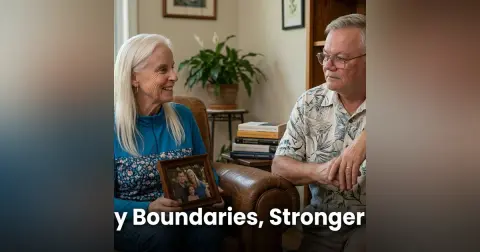

Click on Fan Mail link and give me feedback. Thanks Letting Go Without Losing Love: Communication, Boundaries, and Adult Children James Moffitt talks with Rebecca Mullen, a relationship coach, writer, and author of Six Steps to Better Marriage Communication, about how parents can stay close to adult children without slipping into control, guilt, or mixed signals. The conversation centers on healthier communication, especially how to respect grown children as independent adults while still kee...


Click on Fan Mail link and give me feedback. Thanks
Letting Go Without Losing Love: Communication, Boundaries, and Adult Children
James Moffitt talks with Rebecca Mullen, a relationship coach, writer, and author of Six Steps to Better Marriage Communication, about how parents can stay close to adult children without slipping into control, guilt, or mixed signals. The conversation centers on healthier communication, especially how to respect grown children as independent adults while still keeping the relationship warm and connected.Rebecca shares practical ways to navigate family dynamics, apologize well, and use praise, agency, and boundaries to build trust instead of conflict.
Key topics
- Rebecca Mullen introduces her work as a relationship coach, podcaster, and author focused on clear communication in families and marriage
- The discussion frames adult parenting as a shift from control to mentorship, support, and respect for a grown child’s agency
- Rebecca explains how family intimacy is built through both repeated routines and exceptional shared experiences like vacations and camping trips
- A camping-trip story shows how mixed signals can create conflict when a parent says they want less responsibility but still wants control
- The episode explores how naming grief can help parents understand why letting go feels painful and why they may send inconsistent messages
- Rebecca describes how praise changes family dynamics by highlighting what is working instead of focusing on what is wrong
- The hosts discuss how children learn relationship patterns by watching how parents handle conflict, apology, and appreciation
- Rebecca lays out a four-step apology process that rebuilds trust by saying sorry, naming the behavior, naming the other person’s feelings, and stating a plan to do better
- The conversation distinguishes clean asks from attacks and explains why giving the other person agency increases intimacy
- Boundaries are defined as what you will and will not tolerate, not as a way to control another person’s behavior
Timestamps
00:00 - Opening and introduction to the episode’s focus on adult children and communication
01:52 - Rebecca shares her background as a coach, author, and podcast host
03:21 - Rebecca’s family story, marriage, medical school years, and long-term resilience
06:49 - Why vacations and shared experiences help create family intimacy
09:37 - Respecting adult children as separate people with their own lives
13:15 - Camping trip story: mixed signals and a parent’s struggle with letting go
15:21 - Naming grief and understanding the emotional side of changing family roles
17:56 - The hidden labor problem in marriage and what gets overlooked
24:48 - Assuming positive intent instead of defaulting to blame
26:30 - Why praise works better than nagging or criticism
30:21 - Why children need a safe place to make mistakes and repair them
31:20 - The four-step apology that rebuilds trust
36:39 - Common communication blunders and why boundaries need clear requests first
39:17 - The clean ask formula: overcome fear, get clear, ask cleanly
42:33 - Why agency matters and how vulnerability strengthens connection
43:57 - What boundaries really are, and why they are not punishments
48:56 - Using affirmation to support boundaries without damaging intimacy
51:31 - Rebecca’s closing encouragement and resources for listeners
Notable quotes
- “We all want to feel seen.”
- “An attack is not a clean ask.”
- “Agency in a relationship is the thing we're most scared to give away, but it is the thing that most fully cultivates intimacy.”
Action items
- Ask yourself what you are really afraid of before reacting to your adult child
- Replace mixed signals with a clear, clean request
- Use praise intentionally and look for what is going well
- Apologize with specificity, not vagueness
- Define boundaries as your own limits
Richard Jones. I am an RN with over 34 years of Nursing Experience, much of that experience working with young adults in the corrections system.
Parenting Adult Children Call To Action
Social Media Links
https://www.youtube.com/@abcparentingadultchildren
https://www.instagram.com/parentingadultchildren125/
https://www.tiktok.com/@chiefpropellerhead
ABC's of Parenting Adult Children Facebook Page
https://www.facebook.com/profile.php?id=61581576308055
r/parentingadultchildren
Feel free to subscribe to these channels and share the links with your social media portals.
The clean ask formula is the first three chapters of my book. And it is overcome fear, number one, get clear, number two, and then ask cleanly. When I talk about um overcome fear, remember my story with my daughter that I I get I sent mixed signals. And I sent mixed signals because I was afraid of the identity I was gonna lose. But I hadn't taken time to process that that myself. I needed to get in my own business and get clear about why why do I feel threatened by the fact that she's talking to her dad about meal planning? And I just attacked her. A lot of times we we attack a person and we think we're asking for what we need, but an attack is not a clean ask.
SPEAKER_00There comes a moment in every parent's life when the role they've known for years begins to change. The children they once carried, guided, and protected become adults. And suddenly the questions become different. How do you stay connected without holding on too tightly? How do you continue loving well when relationships become complicated? And while every family is different, no parent should have to navigate these questions alone. Each week, James Moppet brings together experts and parents who have walked this road before to explore the realities of parenting adult children. Through honest conversation and practical wisdom, listeners find hope for the journey ahead. Whether your relationship is thriving, strained, or somewhere in between, there is hope, there is healing, and there is always the possibility of a stronger connection. ABC's of Parenting Adult Children. Helping parents navigate loving their adult sons and daughters well.
SPEAKER_01Hello and welcome back to the ABC's Parenting Adult Children Podcast. My name is James Moffat, and I will be your host. Today we have a special guest named Rebecca Mullen. How are you doing, Rebecca?
SPEAKER_02I am so well and I'm so thrilled to be here with you, James.
SPEAKER_01Rebecca is a writer and coach who helps families navigate the delicate balance between independence and intimacy. We're talking about what it means to let go, not in despair, but in faith. If you've ever wondered how to stay close to your adult children without crossing boundaries, this episode is for you. So, Rebecca, thank you for being on the show this evening. And do me a favor and introduce yourself to the listening audience, please.
SPEAKER_02You know, I love this premise that your podcast is based on the idea of giving our adult children independence and launching them in a way that creates really healthy boundaries. And I will say that that, you know, I was attracted to your work because my work is centers around relationship communication. I've been a relationship coach for two decades. I have a book, Six Steps to Better Marriage Communication. I host a podcast, Habits for Your Happily Ever After. And I have been searching after this question of how do we make our relationships the best they can be? And often that boils down to really clean communication. So I'm thrilled to be here talking with you about that today.
SPEAKER_01Absolutely. So where are you from?
SPEAKER_02I live in Colorado. I was born in Illinois.
SPEAKER_01Okay. So throw a while throw away the resume and tell our listeners who you really are.
SPEAKER_02I am the mother of Caitlin and Logan, grown children. My husband's name is David. I met my husband David when we were in junior high school, if you can believe it. Wow. We dated some, broke up some, dated some, broke up some, but eventually we were in our high school musical of the music man. Dave was the music man, and I was Marion the librarian. And we have a story. He I married a carpenter. He, 10 years into our marriage, I was pregnant with our second kiddo, and he said, I want to change. And I patted my belly saying, The change is coming, sweetie. But he wanted to go to medical school. And so we spent the next 10 years of our time together figuring out how to get him through getting an undergraduate degree through medical school, his residency. We moved many times during all of that. And several of my family members died during that time. So our relationship has been tested.
SPEAKER_01I bet. So how long how long have y'all been married?
SPEAKER_0238 years, almost 39.
SPEAKER_01Wow. So Katie and I are working on 37.
SPEAKER_02Congratulations we're at the same stage.
SPEAKER_01That's right. Yeah, we're empty nesters. We have four we had four children. Two of them are still alive. We lost two of them.
SPEAKER_02And uh James, I am so sorry.
SPEAKER_01It sucks.
SPEAKER_02Yes, it does.
SPEAKER_01Parents never expect or should have to bury their children.
SPEAKER_02No. No.
SPEAKER_01Anyhow.
SPEAKER_02Yeah. And I'm sure that tested your marriage as well.
SPEAKER_01Yes. Yeah. We had a daughter, Jessica Ann, that passed away in 2001. She had a brain tumor with two different types of cancers, and she lasted about 14 months. And then I had a 38-year-old son that passed away in January of 2025.
SPEAKER_02So very that's a very recent loss.
SPEAKER_01Yeah.
SPEAKER_02And was his death uh related to an illness as well?
SPEAKER_01Yes. He wound up in the ICU in Michigan with RSV of the lungs or something like that. Whatever RSV is, I don't know.
SPEAKER_03Yeah.
SPEAKER_01I guess it's some kind of viral infection. Then he had pneumonia. And uh he was uh quite a bit overweight, which I think is what ultimately wound up doing him in in anyway.
SPEAKER_02I am so sorry. So you and Katie are facing this very trying time of trying to figure out how do you grieve and lean on your sweetheart at the same time. That's really challenging. Yeah.
SPEAKER_01Well, Jeremy and I were we weren't estranged, but we weren't super close either, right? So so that sort of helped. You know, we miss him, we love him, but it wasn't quite as raw emotions and pain as it was with our ten-year-old daughter. But anyway, as we always say, marriage, families, relationships can be messy and they're difficult.
SPEAKER_02They are messy and difficult.
SPEAKER_01I'm looking forward to hearing you talk about relationships between parents and their adult children because as as teenagers uh transition into adulthood, parents have to transition into the role of a mentor and support person. And so it it requires a lot of unique and skilled communications ability to keep the relationship going, right? And uh so I'm looking forward to talking about that.
SPEAKER_03Yeah.
SPEAKER_01So you before we hit records, you said there was a uh you had a little presentation or something that you wanted to present to the listening audience.
SPEAKER_02It wasn't so much a presentation as just I gave some thought to this idea of how do you entice your children to take vacations with you after they've left the nest. Because there's probably two, you know, when I when I coach couples, I say there's two main ways that you create intimacy in a family. One is the things you do over and over and over. And the other is those exceptional times when you're doing something drastically different. So when my children launched the nest, I don't have tons of things that I do with them over and over and over. I'm trying to establish some of those routines with my grandchildren. But the one thing our family is really good at is vacations. We have taken great vacations when they lived with us. And now we try to take two vacations a year. One of them is sort of a staycation at our home. And the other one, we try to take an adventure, whether that's a river trip or a backpacking trip or something else of that nature. We're adventure family people. So I just wanted to be, you know, I felt like that was one thing that I've given some thought to. And I know that your listeners are eager to hear how do I relate to my adult children? And being able to communicate with them about a vacation and how to get on the same page, well, that's something that I thought I might be able to add value to your listeners with.
SPEAKER_01Absolutely. I think I think uh when you become an empty nester and children move on into their adult lives and have families of their own and careers, sometimes it's so difficult at best to keep the line of communications, you know, connected.
SPEAKER_03Yes.
SPEAKER_01A good, healthy, you know, line of communications.
SPEAKER_02Mm-hmm. So that healthy communication is all about respecting your children as adults. And as you've already alluded to today, that's a hard thing for us to update our reality that these children, you know, I I bought their underwear, I folded their socks, I packed their lunches. I have to update my reality to say, yeah, but these kids are no longer my babies. These are grown adults with agendas for their own lives, schedules for their own lives. And if I want to be with them, I need to find a way to fit into their life rather than asking them to fit into my life.
SPEAKER_01Right. Very good. So can you talk to the the about the transition period as as the teenagers turn into young adults and the transition the parents need to make and and how they can navigate those waters?
SPEAKER_02Yeah, it's such a good question, right? Because as parents, I almost think we're we need to approach that question from the very beginning. How can I respect this little tiny baby that is reliant on me for all their needs, but I want to respect them as their own individual and be able to see what do they need? What do they want? Who are they trying to become? And it's my job as their parent to facilitate that for them. So if I take that attitude with my young child, then a baby turns into a 10-year-old who has some more independence. They want to, you know, go and take a bike ride around the neighborhood with their friend. And then that 10-year-old becomes a 20-year-old who not only wants to ride their bike out of my driveway, they want to move out of my house. And I need to be able to think about that child as a fully realized adult who can make their own choices. And so am I training them while they live in my house? Am I training them to deal with adversity in a way that I empower them to do that? And then am I treating them as an adult with full agency over their own life that I can begin to suggest how I want to interact with them and their family and their children in a way that really respects them as a person. I I have couples come to me that are, you know, dealing with conflict with their grown children. And that boils down to expect, you know, the parent expects that grown child to still bend to their will. And once a child is off on their own, that's the last thing they want to do, right?
SPEAKER_01Yeah, that's not gonna happen.
SPEAKER_02That's not gonna happen. Yeah. So we have to find a way to make it attractive to want to spend time with me as an adult. I want to become a person that my children long to come to, either for advice or help with children, or just to spend some recreational time.
SPEAKER_01So I was out in public at one point, like we all are, right? And I I witnessed a phone call uh between a young man and his parents. I don't know if it was mom or dad. And fortunately for me, he didn't have his phone on speaker. He actually had you know earbuds on, you know, or something. But the thing that uh I had to chuckle about, they were having a debate about something, whatever it was. And he says, he says, I'm an adult now. You can't tell me that. I was like, you go.
SPEAKER_02You go, right? Yeah, I am an adult.
SPEAKER_01Oh, somebody's in trouble.
SPEAKER_02Yeah, and I think, you know, it's tempting for us as parents to infantilize our grown children because there's a lot of grief in our children no longer needing us. And so we sometimes treat our children like they are still children long after they've emancipated, because it's sad to realize they don't need me anymore.
SPEAKER_01Right.
SPEAKER_02Yeah.
SPEAKER_01So let me throw you a curveball. So talk about a obviously respecting privacy here, but talk about a conflict, either a conflict that you and your adult children or teenagers, and tell us how you navigated those waters and how you how you were able to keep the boat on even keel and not destroy the relationship.
SPEAKER_02Well, what's coming to mind is we were taking a camping trip, and our family has taken many, many camping trips. And my daughter and I are typically the food prep preparers. We talk about the menu, we make it together since she was a teenager. And there was definitely a time, you know, this is long after she's moved out of our house, but we're planning a camping trip together. And I had, I was giving mixed signals to my daughter. On the one hand, I was saying, I would like to back up from some of my role in creating family vacations because I would like to have more time to do my professional work. So on the one hand, I was saying that. And so my daughter picked up on that and she reached out to her father and they made a menu and she created this whole spreadsheet and assigned meals to her siblings and had a plan with her dad. And then I felt left out. And I came along and I said, Hey, what are you doing talking to your dad about that stuff? That's something we do together. And what's so cool, James, is that she called me out on it and she said, But you're kind of sending mixed signals because you have said you want less responsibility in this realm. So dad and I made a plan. And I had to take a deep breath and take some of my own coaching advice and realize, oh, that's true. I was giving mixed signals. And this is this is kind of what we were talking about before with you want your kid to launch, but then they do launch and you don't have that same, they don't need you. They nobody needed me to make all the meals. And I felt like, well, I don't know where I belong in our family vacation then. So we we just had to talk it out. She thankfully was respectful as she called me out and said, you're kind of misbehaving because you're sending mixed signals. And there were some bumps there. But I think what helped is that I was able to name my grief and why I was sending the mixed signals was that I was trying to find my new place in her life. And she could understand that. Once I named that feeling, she was like, okay, I understand that. But just make sure that you behave better in the future is kind of the bottom line of that story.
SPEAKER_01Well, it sounds like your daughter's a very good communicator and and and mature. I don't know how old was she at that time?
SPEAKER_02Mid-twenties. Okay, yeah. Yeah.
SPEAKER_01That's great. That's a great example. I like that.
SPEAKER_02Yeah, I think that she had grown up in a household where communication was really valued. And that as long as you were speaking from your place of emotion, like I'm feeling next. So she was feeling hey, I'm confused. You said this on the one hand, and now you're saying this on the other hand, that's a you problem, not a me problem. And I I had to listen.
SPEAKER_01Yeah.
SPEAKER_02Yeah.
SPEAKER_01So so as we as I said earlier, families, relationships, family dynamics, relationships, communicating. That's all that all that all can be very messy uh and complicated. And so let's talk about family dynamics. Just a typical family of four, let's say. And uh you got mom and dad, and you got a got a boy, you either a young man and young woman, teenage years, fairly old, you know, sixteen, seventeen years old. And let's talk about we always talk about uh the importance of fathers being not only physically present in the home, but also emotionally and spiritually, you know, aware of what's going on with the family members, especially the children. And and so let's talk about the family dynamic and how you know there's a lot of fathers that are they might be physically present, but they've got careers, they're going to school, but but maybe they are not picking up on the cues, maybe they are not aware of the things that are going on inside the the family. And so that that creates a kind of a communications deficit in the relationships, right? So how to how do how do fathers or parents in the family overcome that sort of thing?
SPEAKER_02Oh boy, you're naming a phenomenon that is just at the heart of so many communication missteps, right? I know that there were times in my marriage that I felt like saying to my husband, hey, could you just land? I mean, your body is here, but I don't feel like your mind is here. And I I have to admit to you, James, that I kind of shamed my husband in that way and sort of made him feel less than that he was, you know, that I was carrying the bulk of the emotional labor in the household. And shame is the worst thing for giving people an invitation to show up more. And as the years progressed, I was very humbled because I just, there was so much I was busy with raising our children and tending to things in our home to put my husband through all those years of schooling. I felt overburdened. There is no doubt that I was tired. But instead of recognizing that I was tired and maybe he was tired as well, I sort of blamed him that he wasn't doing his fair share because I felt like I was doing more than him. But then I began to see the weight of his career and how much energy it took for him to change careers, how much energy it took for him to show up in an emergency room as a physician. I don't know if you've seen the show The Pit that is out these days, but it's a very realistic depiction of what it looks like in an ER. And as I've watched that show, I am becoming humbled by all that was in the background for my husband. And in the same way that some of my labor was invisible to him, his labor was invisible to me. And one of the great things about this emptinessed era of life is a lot of just the logistics of life have show slowed down. And so it's allowed both of us to have time to notice each other more. And my my marriage has gotten so much softer because there's been time for me to just say thank you to my husband for carrying that burden and not complaining for working so hard at a job that I didn't understand how hard it was. He never he never complained about his work. And so I've owed him some apologies. I don't know if that's answering the question that you're asking.
SPEAKER_01Yeah, absolutely.
SPEAKER_02Okay.
SPEAKER_01Well, yeah. I have to give kudos to moms. Absolutely. Because I I feel like mothers they do a lion's share of the work in the home. Right? And and I think that moms and dads in their relationship to one another should be a team. They should be leading one another and serving one another in many aspects, right? And I think that I loved your your comment about how uh you recognized the fact that you were shaming. Him a little bit for supposedly not showing up in in the way that you expected or needed him to. And that might have been true. Maybe, maybe that was true, and maybe he wasn't. But I think that I think that how do you say this? Well, let me just tell you a little bit about my wife, Katie. We we've been married a long time, and uh she's put up a w with a lot of crap for me over the years. And when we first got married, I had just gone through an ugly divorce, and I was very selfish. Very just very, very selfish, to the point of I would not share food out of my plate with her. I almost stabbed her with my fork one day while we were dating, and she reached, just lovingly reached into my plate to pick a morsel of food up, and I had to stop my I had to stop my hand from stabbing her. I was like, and she was like, what's going on? I'm like, you know, I just went through an ugly divorce and I was, you know, lost my child, lost a lot of physical things, my life was wrecked, you know, and and so anyway, uh my wife is the most loving, compassionate, tender-hearted, giving person I've ever met in my entire life. And so she taught me how to share and how to love and how to be compassionate because she modeled it in front of me. You know, a lot of a lot of people get into marriages and relationships, and they think, you know, during the dating, obviously during the dating period, everybody's putting their best foot forward and you know, getting dressed up for date night and and being polite, and the men are opening the doors for the women, and all of this stuff that all this stuff that you go through during the you know, the mating, not mating, courts, but courtship, yes. And uh but once you get married and you say I do and you're living together, well, then all of a sudden people see the real you. You know, they see not only the good things, but they see the bad things. They see the bad habits, you know, and they see the things that, you know, irritate them, probably. And before they said I do, before they got married and made that commitment, they thought maybe even if they kind of gathered some of the either idiosyncrasies or bad habits you might have had, they thought they had an unrealistic expectation of I can change him. Right.
SPEAKER_03Or I can change her. Yeah, yeah.
SPEAKER_01Well when we fall in, we're in love and we're gonna get married, and we're gonna have a house with a white picket fence and four children and lots of money.
SPEAKER_02Love will conquer all.
SPEAKER_01No, and and then all of a sudden reality sets in, right? And all of a sudden you realize the person that you love, you gotta love the good things and the bad things. You gotta accept both of them, you know, and you you're you love them, but your love is not going to motivate them to change. Your love is not going to just automatically, they're not just gonna metamorphosis into this wonderful person that you want them to be, you know, because you have this unrealistic expectation. But but uh I think that if husbands and wives will just love themselves, love each other more, and not judge one another less, you know, judge one another less, and be more compassionate, more giving, you know, more uh forgiving, and and help, help, help your mate change, you know, help help them to improve. You know, and you you don't help them improve by shaming them or being angry or embarrassing them in front of the family, you know, whether you be your kids or your your external family, right?
SPEAKER_02Right.
SPEAKER_01So I thought that was a good point she brought up.
SPEAKER_02Well, and I had a therapist that was on my podcast once, Chantel Landeros, and she said, When you're dealing with your sweetheart, assume that they have a positive intent. And that assumption, you know, like when when I didn't feel like David was participating in the emotional labor of the house, if I could have assumed that he had a positive intent, I would have gotten curious and gone looking for, okay, so what where is the evidence of David's contribution in this home? I would have stopped thinking so much about myself and I would have been thinking about what it's like to be David and thinking, oh, I bet it's scary to go to graduate school when you've been a carpenter for 14 years. I bet he's facing a lot of fears and we are his safe place. And so when he comes home to the safe place, all he wants to do is bask in the fact that he's home with us rather than asking him to take on a leadership role or burden him. And I'm not saying that that um dad's, you know, and the next generation is so much better at balancing this emotional labor. But like I'm not trying to let him off the hook from that, but I am trying to notice wouldn't it have been great if I had highlighted to my children, hey, I bet your dad was scared today and he did something anyway. Let's ask him to tell us about that. That would have been a much gentler, kinder way to have approached the situation.
SPEAKER_01And I I have heard and I've seen where there's one thing that you can do that people just love. You know what that is?
SPEAKER_03Tell me.
SPEAKER_01Praise.
SPEAKER_02Yes, right. We all wouldn't say that.
SPEAKER_01People respond to praise.
SPEAKER_02Yeah.
SPEAKER_01You know, what do you do do you want somebody just nagging at you and going in and highlighting all your negative traits and you know, highlighting where they're fault, failing, you know, and all of that? Or do you think they would respond better if you took the time to thank them for what they are doing? And that goes both ways, husbands to wives and wives to husbands, you know?
SPEAKER_02And when we go looking for what our sweetheart is doing that is quote unquote praiseworthy, we actually see things that we didn't see before. Because we all have a negativity bias, and our negativity bias predisposes us to see what's wrong, what's missing, what needs fixing. But if we override that negativity bias and say, what's going well? What do I want to praise in this moment? Suddenly there's a thousand things we didn't see before.
SPEAKER_01Right. And when you and when you when you are positive and you're praising somebody for for who they are and what they've done, that makes that person want to be so much better.
SPEAKER_02I know, right? I know.
SPEAKER_01Like they sit up and they go, Yep.
SPEAKER_02Well, thank you. Yep.
SPEAKER_01I want to do more of that.
SPEAKER_02It's sort of like inviting someone into their best self. When we see their best self, people want to be more of that best self. Absolutely. Couldn't agree more.
SPEAKER_01So while that works for mom and dad, guess what you're doing? You're you're role modeling that for your children.
SPEAKER_02Isn't that the truth?
SPEAKER_01And you're you're teaching your children how to treat the opposite sex or how to treat their uh love interest or their mate or boyfriend, girlfriend, whatever you want to call it.
SPEAKER_02Yeah.
SPEAKER_01And when you're modeling that behavior and those communication skills and using praise and not being negative, then that teaches your kids that's how mom and dad navigate conflict. And that's how they're that's how they worked it out. Right? And so so they're they're going to default typically to what they see at home.
unknownYeah.
SPEAKER_02Not to mention, then when we treat our child, when our home is an environment of seeing the great stuff, our children are gonna want to return to that kind of environment. Because we know that the world outside is doing the opposite. But when we cultivate an environment of, hey, we see the best in you in this place, what a kid isn't gonna want to return to that.
SPEAKER_01Right. It it really, really helps to have a safe place. Your home has to be a safe place, a safe space. It has to be, you're you want your kids to be able to come to you. I always told my children, never lie to me. I said, you don't have to lie to me. Because I'm your dad, I'm your father, and I love you. And I said, There's nothing that you can tell me that's gonna make me hate you. You know, you can come to me and tell me anything you can tell, you know, even if what you did was wrong. You know, even you even if you come to me and say, hey, my teacher hacked me off today and I slapped her or I accidentally hurt her or, you know, whatever. Now there's consequences to behavior. However, they need to know there's a safe place that they can come to and tell you those things so that you can help them navigate through that, right?
SPEAKER_02Yeah. Boy, isn't it the truth that we want our kids to make some of their biggest mistakes while they still live in our home so that we can help them navigate and find the resilience and the way through to the other side. Because they're gonna make mistakes out in the world. I want them to be able to feel like they've they have a safe place to make a mistake, be loved, and have someone cheering them on to find alternatives for how can I repair what I messed up.
SPEAKER_01So I'm looking at your your podmatch profile. We just love PodMatch, don't we?
SPEAKER_03Yeah.
SPEAKER_01I'm just I'm just gonna send a shout out to PodMatch.com, Alex and Alicia, and the great job they're doing for uh matching podcast hosts with guests. It's a wonderful job.
SPEAKER_02Helping us find each other.
SPEAKER_01Yes. So tell me about the four-step apology that actually rebuilds trust, not just ends the fight.
SPEAKER_02You know, this is such a great thing to lead into after our discussion that we just had about when your child makes a mistake, that you can create an environment of safety for them when you apologize for things. When you apologize, so many people are afraid to apologize because it, well, first of all, is super vulnerable. But secondly, some people think that it'll make me look weak. But actually, what I have noticed is a really good apology builds trust. It makes the relationship stronger. But it takes these four steps that I'm gonna articulate. The first one is simply say the words, I'm sorry. I can't tell you how many people, James, have told me, I apologize for that. And they never once said a word like I'm sorry, or I apologize for. What that does is it calls attention to the moment in a very unique way. So don't skip the step of saying, I'm sorry. I want to apologize for. And then step two is to name the offensive behavior you did. To my daughter, I would say, I'm sorry. I gave you mixed signals. So I'm using the words I'm sorry, calling attention to the fact that I messed up, and then I name the behavior that hurt her feelings. Step three is to name her feelings. I bet that made you feel confused. I bet that made you feel frustrated because you spent all that time doing the spreadsheet with your dad. And then I came and said, Hey, why did you leave me out? I bet that made you feel like you couldn't win with me. When we name someone's feelings, or even just name them and then say, Where am I wrong about how I made you feel? Or where am I wrong about the feelings that resulted from my poor behavior? That's where we really build some trust because we see and we name the consequences of our behavior. And that's where the trust can be regained and built stronger because it's sort of like saying, I messed up and I bet that made you feel this way. And that's when your child feels seen. And like we've been talking all hour, when we feel seen, my gosh, that's a relationship where we really want to show up. And then the final step, step four, is to simply say, Here's my plan to do better. So I said to my daughter, my intention going forward is to stay in the background. I asked for this. I want permission to be able to cry a little bit about the identity that I'm losing, but I will handle that on my own. I will do those, I'll shed those tears with my friends and not burden you with that. And I'm gonna celebrate as you make plans with your dad and cultivate this new relationship with your dad.
SPEAKER_01That's awesome. And I think the only thing that I would add to that is that body language and tone of voice go a long way in communicating that you are sorry. Right. And uh, because I always I always told my, well, I think my parents, whoever, somebody as I was growing up said, it's it's not what you're saying, it's how you're saying it.
SPEAKER_03Right.
SPEAKER_01Right? Are your arms crossed? Are you towering over somebody? You got a smirk on your face, you know, what your tone of voice sucks, you know. Well, I'm sorry. And I'm sorry.
SPEAKER_02Don't you think that the heart of that is actually feeling sorry? Like you can say I'm sorry, but if you don't feel sorry, you don't sound sorry. And then you're actually making it worse because you're giving lip service to something that is obviously not true. And that's sort of like gaslighting someone, kind of saying, Yeah, your your hurt feelings don't really matter to me.
SPEAKER_01Well, and don't you realize that parents are always right? Children are not always children are not right because kids, they haven't lived, you know, 40 or 50 years. What do they know? You know, I'm the parent, I'm the authoritarian figure in this household, and I'm the dad. And you know, if I tell you thus and so is thus and so, then you have to take that, you know, blah, blah, blah. And you're like, yeah, okay, whatever. And uh, you know, it's sometimes it's tough for adults, for parents to admit that they screwed up, you know?
SPEAKER_02And and I always it is such a it's such a teaching opportunity, right? If you can do that as a parent to your child, apologize to your child, holy cow, do you have an enormous outsized influence on their life?
SPEAKER_01Absolutely. And they'll they'll remember that.
SPEAKER_02Oh my god. And and how much better life do you live if you're able to say, I made a mistake? That lets you off of so much pressure and so it just allows you to live with more freedom.
SPEAKER_01So let's hop, skip, and jump over to the good intentions, bad delivery, the most common communications, blunders, and their fixes.
SPEAKER_02Well, I have a lot of people come into my office because I'm a relationship coach. And so I always, as people are coming into my office, I'll say, What's the thing you most want to work on? And they'll say, I need to learn how to build boundaries. And so, yeah, absolutely. That's the sixth chapter in my book is all about building boundaries. I can do that. I can help you. And then I'll say, What is the boundary that you feel like you're struggling with? And then they will say to me, James, well, that's what I need your help figuring out. And so one of the one of the communication blunders that happens in relationships is just like I shamed my husband because he wasn't emotionally contributing the way I wanted him to, I didn't take time to do the first five steps before building a boundary, which is get really clear about what I wanted and then get really clean about asking. Could you participate, you know, at the family dinner table? Could you ask some questions? Could you reveal some elements from your day? And then another element before building boundaries is we tend to love conditionally. Like I was sending a signal to my husband, I'll love you if you show up emotionally at the table. If you don't show up emotionally, I'm gonna fold my arms, I'm gonna shame you, I'm gonna shake my finger at you. I will love you if you do it the way I want you to do it. Well, that doesn't work. And then one more thing before you build a boundary is to affirm lovingly those traits that you do like. I mean, we've been talking about this so much today that when you call out the behavior that's valuable to you, when I say to my in front of my husband to my children, boy, isn't your dad courageous to make this career change? Isn't he courageous to step into an arena that is scary for him and do it anyway? When I do all those steps, then I can build a boundary around this is how our family behaves. Our family trades conversation and engages in conversation. And if you don't do that, then maybe I'll call you out about it. But I think so often communication blunders happen, James, because we haven't taken the time to get clear first about what it is we truly want in the communication. Does that make any sense to you?
SPEAKER_01Yeah, absolutely. So the clean ask formula, how to say what you need without starting a fight.
SPEAKER_02The clean ask formula is the first three chapters of my book. And it is overcome fear, number one, get clear, number two, and then ask cleanly. So let me uh I'm just gonna reach for my plug for just a second. My battery is about to go out. I'm when I talk about um overcome fear, remember my story with my daughter, that I I get I sent mixed signals. And I I sent mixed signals because I was afraid of the identity I was gonna lose. But I hadn't taken time to process that that myself. I needed to get in my own business and get clear about why is why do I feel threatened by the fact that she's talking to her dad about meal planning? And I just attacked her. A lot of times we we attack a person and we think we're asking for what we need, but an attack is not a clean ask. So when we back up and and nurture our own fear or name our own fear, like when I said to my daughter, I think I feel like I'm losing a part of my connection to you. That's me naming that fear, naming what I'm afraid might happen. So that's step one of the clean ask formula. Step two is to get clear about what you want. I was sending mixed signals, James, because I didn't, I didn't know what I wanted. I wanted my identity to stay the same in my daughter's life, but I wanted less work demands. Well, those things were in conflict with each other. So I had to get clear. Yep, I might lose a little bit of my identity as the meal prepper, but I really want the extra time. So I had to get clear about what I might gain and what I might lose and what my heart's desire truly was. And then step three is to ask cleanly for what I want or what you want. And that involves giving agency to the person that you're talking to. So when I say, would you be willing, daughter, to include me in the ideas about food and then go to your dad to plan the logistics so that I still feel included, but I don't have all the work. Now I ask that question in a way that hands the agency to my daughter. Would you be willing to do this specific thing? And she can answer yes or no. And James, I gotta tell you that this is the sticky point in my practice because we don't want to ask in a way that gives the agency to the other person because we like having control. So we ask in a way that preserves our control. We say, you should do it my way, you should take out the trash, we should go on a date this Friday. There's no agency sharing. And we imagine that preserves our vulnerability, but it doesn't. It just makes the other person feel lousy.
SPEAKER_01So talk a little bit more about agency.
SPEAKER_02Yeah. Agency in a relationship is the thing we're most scared to give away, but it is the thing that most fully cultivates intimacy. So if I give my husband the choice of going out to dinner with me on Friday night, he might say no. And I might feel lonely as a result. But if I don't so so, in order to preserve that vulnerability, I just tell him what should happen. We should go out to dinner on. Friday night. But when I do that, I leave a whole bunch of intimacy on the table. I I don't allow him to enter into my invitation. Right. So giving your communication partner the chance to say no, offering them the agency that they may not want to do what you're asking, although it feels vulnerable, it's also the path to connection. Does that make any sense?
SPEAKER_01Yeah. Yeah. That was that was a great explanation. I don't think I've heard of that before.
SPEAKER_02It's like I should be a relationship coach or something.
SPEAKER_01Yeah, absolutely. So the last the last question is why boundaries fail, the steps most people skip.
SPEAKER_02Yeah. And we've kind of talked about this a little bit in that, you know, if you don't ask cleanly, let me back up. A boundary is not so many people misunderstand a boundary that it is, I'm gonna make another person behave a certain way. No. A boundary is what you have agreed with yourself that you will no longer tolerate. So let me see if I can use the example with my daughter and the vacation planning. I was sending mixed signals. So right out of the gate, I am not setting up a good boundary because I'm not even making a clean ask about what I want. So before I can have a boundary about, I don't want to do so much work for the family vacation meals. That's my boundary. I want to do less meal prep. I'm willing to prep one meal, but no more. That's my boundary. But so many people make the mistake by sending mixed signals the way I did with my daughter. Hey, why are you planning with your dad? Well, I'm violating my own boundary when I do that, right? Another way that people violate their own boundary is they kind of send conditional love messages, like, if you don't do it my way, I'm not gonna play, or I'm not gonna come, or I'm not gonna be happy on the vacation. That's not a boundary either. That's just unconditional love wreaking havoc on your relationship. A boundary is I know my limit. I'm gonna set everybody up ahead of time by asking cleanly for what I want. And I'm gonna ask cleanly by naming what I'm afraid of, what I really want, and then I'm gonna ask you in a way that implies yes or no. So you have the agency to say, I don't want to do it your way. And then I have to go back to myself and go, okay, if they don't want to do it my way, how am I gonna adjust my boundary? Am I gonna hold firm or am I gonna negotiate about this? Does that make any sense?
SPEAKER_01Yes, yes, it does. And it it kind of opens a Pandora's box.
SPEAKER_02Yes. Well, and boundaries are a Pandora's box, right?
SPEAKER_01Well, we we hear so many stories, or I hear so many stories about. I mean, we've got a Facebook support group, and I've got a support group on Reddit, and I read these stories all the time about parents and their teenagers or parents and their young adults struggling with life in general, right?
SPEAKER_03Yeah, yeah.
SPEAKER_01And and I think that parents, you know, I'm a I'm a child of the 70s, and as such, I had very authoritarian parents, and they were very controlling. They were very uh they wanted us kids to be perfect, perfect little soldiers that were seen but not heard, blah blah blah. You know, they did a lot of manipulation. And anyway, I think that you know, I know for my my parents were like, if you if you don't do this, then I'm going to do this.
SPEAKER_02Right.
SPEAKER_01Like if you're not if you don't obey me, yeah, then you're gonna get punished.
SPEAKER_03Right?
SPEAKER_01And so I think I think I think parents and and thankfully, a lot of people that are listening to this episode, they probably weren't parents of the seven or kids in the seventies, and so they don't understand, right? But I think a lot of parents try to control their young adults and their teenagers by what they they consider a boundary. And and in other words, I'm setting this boundary, it's a fence, it's a fence between me and you, and you have to stay on your side and you have to do what I ask you to do, or you're gonna be in trouble. You know? Does that make sense?
SPEAKER_02Well, it's confusing a boundary with a punishment. Boundary is not how I'm going to punish you. A boundary is if you don't clean your room, you're gonna live in a messy room. Or if you don't get home on time, well, then you're gonna lose the privileges to use our car. Those are boundaries that have natural consequences. A punishment is I'm gonna make your life miserable because you didn't do life the way I want you to do. And punishments tear away at the fabric of intimacy and connection, whereas a boundary actually magnifies connection because it says, I'm gonna be a reliable person. I'm gonna show up in the world. And when you behave in a way that your natural consequence is not to respect our household's rules, you may not get the keys to the car the next time. That's sort of a natural consequence's boundary, and I'm gonna hold that boundary. But one thing I want to point out is one of the best ways to nourish a boundary is to affirm lovingly. When we point out in our children, especially, and even our sweetheart, when we point out their capability to live up to a boundary, you are a responsible person. I absolutely know that even though you lost this job, you're gonna find another one. You're gonna find a way to work it out. And do you know why? Because look at the evidence. In the past, three different times you had a bill that needed to be paid and you figured it out. I trust that you're gonna figure it out again. That kind of affirming is sort of, you know, letting your child know we have a boundary. I'm I'm not the one who's gonna pay your bill. But it sets the boundary in a way that affirms their personhood to be able to follow through in their life.
SPEAKER_01That's wonderful. Boundaries is complicated. They are complicated. It's necessary. And I think uh I think sometimes boundaries become a battleground between parents and their young adults when it needs to be something else, differently, something completely different.
SPEAKER_02I think when it comes to a boundary, the question I want to ask myself is what am I willing to do? Any situation, if my child child is asking me for money, or my child needs to move in with me, or my child wants me to take care of their kiddo, what am I willing to do? That's my boundary. And then I communicate clearly about, yeah, absolutely I'm willing to loan you some money, or absolutely I can take care of your kid on Friday, but not every Friday, or whatever it is that I am willing to do, that's my boundary. When it gets confusing is when I begin to say, and your boundary should be, or and you should behave X, that's when you know you have stepped out of the boundary territory and stepping into trying to control someone else. You can't you can't set a boundary for someone else, only for yourself.
SPEAKER_01Very good. So we've had a wonderful conversation, Rebecca. And I always like to give my guests an opportunity to have a little three to five minute elevator speech, elevator talk. And so I would like to give you an opportunity to talk to the parents that are out there listening to this episode. What would you what would you say to them?
SPEAKER_02I don't I that's the hardest question you've asked me tonight. I guess I would want to say, come listen to my podcast, Habits for Your Happily Ever After. I address issues similar to the ones that James has brought up tonight in some depth. We've I've talked on there about codependency and control, which we sort of leaned into with this idea of boundaries. One of my favorite episodes to introduce people to is episode eight of my podcast talks about the transformational power of a single word in your relationship, which is how do you say hello? When you see your adult child walk in the room, does your hello sound like hello, I'm glad to see you? Or does it sound like hello, which is really goodbye, right? One word, the character of the way that we use that one word can open the door of relationship connection or it can close it. I would love for people to come find me. I can I can be found at Rebecca Mullencoaching.com or at Rebecca MullenCoaching on Instagram or TikTok. And I would love for people to check out my book, which is called Six Steps to Better Marriage Communication. And those six steps, while they work really well for marriage, they'll also work really well for how you interact with your adult child.
SPEAKER_01Where do they get that book? On Amazon or where? Sure.
SPEAKER_02Yeah. You can get it off of my website, but you can definitely order it on Amazon. And if you want to hear me read it to you, you can get it on Spotify.
SPEAKER_01Wow.
unknownCool.
SPEAKER_02Yeah, if they like podcasts, then you can listen to me read the book to you on Spotify.
SPEAKER_01Absolutely. Well, I have a I've had a wonderful conversation with you, Rebecca, and I think we covered some really important topics.
SPEAKER_02Yes. James, I feel so privileged to have been invited.
SPEAKER_01So you've reminded us that letting go doesn't mean losing love. It means trusting that God is still writing our story or the story. To every parent listening, your role may change, but your influence remains. Keep showing up with grace, keep listening with love, and keep believing that healing is possible. I also want to say thank you for the privilege of your time. If you listen to this episode, either on Spotify or Apple Podcasts, leave a review. If you watch the video on my Parenting Adult Children YouTube channel, please subscribe and follow because all of the episodes are uh shipped off to either BuzzRout or the YouTube channel where you can you can watch. So I'm James Moffat. This is Rebecca Mullen, and we thank you for your time. We hope you enjoy the episode, and we will talk to you later. Bye bye.


