Parenting Beyond the Nest: Faith, Boundaries, and Respect with Angela Caldwell
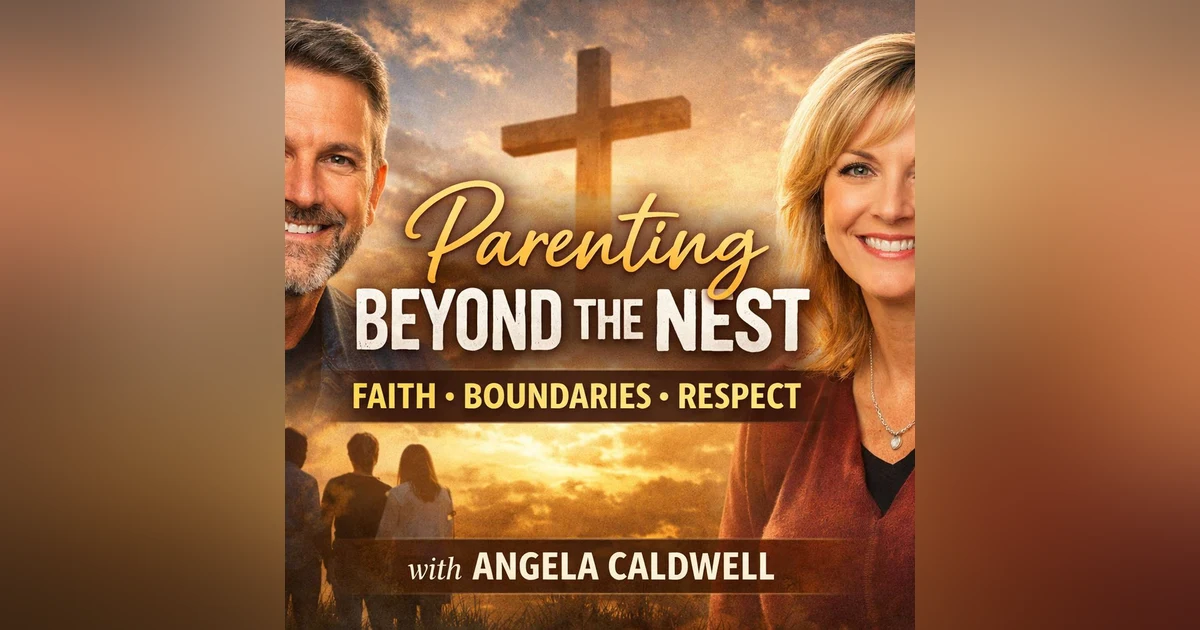
Click on Fan Mail link and give me feedback. Thanks Parenting Beyond the Nest: Navigating Relationships, Faith, and Boundaries with Angela CaldwellJoin James Moffitt and Angela Caldwell as they explore the ongoing journey of parenting adult children. From redefining boundaries and fostering respect to the role of faith and managing conflict, this episode offers practical insights for parents supporting their children through the complexities of adulthood.In this episode: The evolution o...


Click on Fan Mail link and give me feedback. Thanks
Parenting Beyond the Nest: Navigating Relationships, Faith, and Boundaries with Angela CaldwellJoin James Moffitt and Angela Caldwell as they explore the ongoing journey of parenting adult children. From redefining boundaries and fostering respect to the role of faith and managing conflict, this episode offers practical insights for parents supporting their children through the complexities of adulthood.In this episode:
The evolution of parenting: from control to influence at any age
- The critical transition from parent of a minor to supporter of an adult
- The importance of respect and how it fuels influence
- Faith as a guiding compass for adult independence
- Setting healthy boundaries that honor autonomy and parental wisdom
- Strategies to prevent enabling and foster independence
- Conflict resolution tips: shifting from content to process
- Navigating values clashes in today's social landscape
- Dealing with the emptiness syndrome post-child-launch
- The significance of mutual respect in family dynamics
Timestamps: 00:00 - Welcome and episode overview: parenting adult children 02:15 - The ongoing role of parents beyond childhood 04:50 - How family therapy can create lasting change 09:25 - Transitioning from parent of a minor to supporter of an adult 11:50 - Power, control, and influence in family relationships 13:55 - The myth of the perfect parent and parenting failures 16:24 - The impact of external influences on adult children 18:12 - Building respect for influence over authority 19:16 - Faith as a spiritual anchor in parenting 20:22 - Identifying core values through life choices 23:05 - Faith practices that support adult children 26:45 - Living authentically and role modeling integrity 30:23 - Setting boundaries: legal, emotional, and social 33:10 - Expressing concern without overstepping 35:38 - Navigating the "dumpster fire" years of independence 37:02 - Handling differences in political and faith beliefs 39:42 - Respecting ownership and individual paths 44:01 - When conflicts escalate: handling disagreements gracefully 47:33 - The importance of honest conversations about values 50:08 - Connecting through shared experiences and openness 54:30 - Managing the grief of
Richard Jones. I am an RN with over 34 years of Nursing Experience, much of that experience working with young adults in the corrections system.
Parenting Adult Children Call To Action
Social Media Links
https://www.youtube.com/@abcparentingadultchildren
https://www.instagram.com/parentingadultchildren125/
https://www.tiktok.com/@chiefpropellerhead
ABC's of Parenting Adult Children Facebook Page
https://www.facebook.com/profile.php?id=61581576308055
r/parentingadultchildren
Feel free to subscribe to these channels and share the links with your social media portals.
28:50 - [Ad] Mini Goldendoodle puppies
29:31 - (Cont.) Parenting Beyond the Nest: Faith, Boundaries, and Respect with Angela Caldwell
Welcome to the podcast ABCs of Parenting Adult Children. Please join us as we discuss parenting adult children and the unique struggles that it comes along with.
SPEAKER_04Hello, and welcome to the ABCs of Parenting Adult Children podcast where faith meets family and wisdom grows with age. I'm your host, James Moffat. Today I have a special guest, Angela Caldwell, who is a mom, mentor, and fellow traveler on the journey of parenting beyond childhood. Whether you're navigating tough conversations, redefining boundaries, or simply seeking connection with your grown kids, this podcast is your companion in grace, grit, and growth. Each week we unpack the real challenges and joys of parenting adult children with stories, strategies, and soul. Because parenting doesn't end when they leave the nest, it evolves, and so do we. Angela, how are you today?
SPEAKER_02I'm so well, James. Thank you for having me.
SPEAKER_04Yeah, absolutely. So uh tell the listening audience a little bit about yourself.
SPEAKER_02Well, I am a licensed marriage and family therapist in Southern California. I have been working as a primarily a family therapist for a couple of decades now. I I was excited to be on your podcast because I would say a large percentage of my practice is families who are coming in with family conflict with adult children.
SPEAKER_04Okay. So that's right up your alley, huh?
SPEAKER_01I like this area a lot.
SPEAKER_04I uh from time to time I I'll I'll uh ask a Google or ChatGBT to locate uh podcasts for parenting adult children. And apparently there's only five, and this is one of them.
SPEAKER_01Is that right?
SPEAKER_04Yeah, there's a lot of there's a lot of podcasts about parenting, but not very m not many of them are focused on parenting adult children.
SPEAKER_02It's funny we think it kind of as a society that once they turn eighteen we get to wash our hands and we're done, and that is so not the case.
SPEAKER_04Yeah, no. Parenting doesn't end at 18. It just kind of transforms into a different role for the parents. So t how did you get into this?
SPEAKER_02Oh, um, well, it's that's a funny story of failure after failure. Uh I I uh grew up in Texas, um, and I grew up on the border. So I was um it's a bicultural town, El Paso, Texas, and I was exposed to Mexican culture, which is extremely family-oriented. And I also had my own um American family, traditional American family. It was uh we were a big family, both my parents came from big families. And so I was sort of family-oriented to begin with. I was doomed from the start. And uh I left the nest, ran to California to go to film school because I was gonna be a famous director or or some kind of technician on set. And uh I did. I went to film school. I lasted about five minutes in the industry. I do not have the skill for that. I do not have the creativity. Those are sensational artists. I cannot, I could not keep up with my friends and classmates and colleagues. But while I was working on set, I did notice that I was the people person. So, so different uh production members were coming to me to say, you know, so-and-so actress is having a problem with so-and-so producer, can you go talk to her? Or, hey, it doesn't seem like the lighting department is cooperating with the camera department. Can you go mediate? And so I learned that I sort of had this people skill. I was I was good at refereeing conflict between people.
SPEAKER_04Right.
SPEAKER_02You know, film sets are like families. You become you're you're working 18-hour days, you're living, sleeping, eating, breathing together. And so it was I could, I could sort of adapt some of my homegrown skills to a set. And then I ultimately decided, aha, this is what I need to do. And so I went to MFT school and became a therapist. Interestingly, I actually started off as a one-on-one therapist. I wanted to be an individual therapist and just work one-on-one and dive into someone's, you know, childhood trauma and conflict. And I did, and it was okay. And I was able to affect change now and then, but I noticed that I just kept sending the person back into their environment. And the environment was way too powerful for me one hour a week in some room somewhere. And so I pivoted about five or six years into my career and I decided, you know, that's it. I need the whole team in here. I need, I need mom and dad, I need brother, sister. I sometimes had roommates, I sometimes had nannies, boyfriends in the room so that I could actually mediate the conflict right in front of me. And that's when I started getting inspired. Because then I could make I could help make families affect lasting change, change that actually sustained once they went home. And I got super excited about that and have been excited ever since.
SPEAKER_04Oh, that's awesome. Yeah. Well, family dynamics can be complicated.
SPEAKER_01And to say the least.
SPEAKER_04That's an understatement, right?
SPEAKER_01That's right.
SPEAKER_04And uh so it's it's nice to know that uh these options are available for families.
SPEAKER_02Yes, yeah.
SPEAKER_04I was raised in the I graduated high school in May of 1980, and so I was you know, uh born in 61, so I was a child of the seventies and eighties. And um there were still a lot of family conflicts around. You just didn't hear about them because people didn't talk about that sort of thing outside the front door.
SPEAKER_01Right.
SPEAKER_04I certainly the family that that I was a part of, my sister and I were adopted and we had a horrible childhood. And looking back I wish that my parents would have availed themselves to somebody like you. It could have made things so much better. But they didn't.
SPEAKER_02Yeah. Well, you know, it's it's that's not the first time I've heard that. I I'm sorry to hear that you had it rough. In the time that you grew up, family therapy was not actually very common. We're sort of a newer addition to the field as of the sort of the 70s and 80s, um, is when it became more more well known and more popular. Before that, before we existed, people went to pastoral counseling. They went to clergy to to help with things. And not everybody had access to that, and not all the churches and synagogues had staff that were capable of non-problems.
SPEAKER_04Well, my both of my parents worked at Terrell State Hospital in Terrell, Texas. And I I was raised in Quinlan, Texas. And uh my dad and my mom, yeah, hook them horns, there you go. Uh my uh my wife actually graduated from UT.
SPEAKER_01Hey, there's there's a lot of.
SPEAKER_04So I know that. But anyway, uh my sister and I were both adopted in an orphanage in a Schaffenburg, Germany. My dad was a drill sergeant in the army, met my mother in Austria, and uh they got together on it at a bingo game and they tried to have kids, couldn't so they said, Hey, let's go to this orphanage and you know, Schaffenberg and adopted uh a little girl. So they adopted my sister. One year later they came back, and the nun said, We're not supposed to tell you this, but she has a blood brother over there in that crib. And so my dad walked over and picked me up out of the crib, and I grabbed the hat off the top of his head and threw it across the room and laughed at him. And uh I guess he fell he fell in love with me and said, Oh, I'll take this one too. Thank God. And uh so they they brought us back and uh my dad uh retired in nineteen sixty-nine, I think, and from Leesville, Louisiana at Fort Polk. So he picked us all up and dragged us back to Quinlan, Texas, where he was born and raised. And so anyway, yeah, I've I've spent I've spent half my life in Texas and half my life here in South Carolina. And so he turned me into a Dallas Cowboy fan in like 1969, 1970. Something like that.
SPEAKER_01That's the best cult that exists.
SPEAKER_04So I I I got to see Dallas when they were a real football team and knew how to play the game.
SPEAKER_01I can hear all the Dallas fans cheering.
SPEAKER_04Yeah. Well, I I'm an undercover Dallas Cowboy fan. All my memorabilia and jerseys and rings and placards and stuff like that are in the house. They don't see the light of day, and I don't I don't ever I'm not the Dallas fan that walks around with his jersey on because I'm just so disappointed in him anymore.
SPEAKER_01I don't think you're alone. Wait, let's let's keep rooting for him though, quietly. Hope they turn it around. Yeah.
SPEAKER_04So I I said all of that to say that, hey, we got a lot in common. I'm from Texas.
SPEAKER_01We sure do.
SPEAKER_04Yeah. Yeah, so um so we're deal we're talking to the listening audience, which is parents of adult children ages between 18 and 30, right? So uh one of the one of the um topics that comes up here is kids become adults, you know, they're preteens or teenagers, they become adults, you know, at 18, 19, 20, whatever. Some children leave the nest, some some kids go off to college, some go to trade schools, some just launch and don't do anything other than just trying to survive. And parents sometimes forget to transition from the parent-child relationship to that of a support person or a mentor. So can we talk about that transition a little bit? Why it's important?
SPEAKER_02All day long. Let's talk. Um I you know, it's one of the more difficult transitions. When you go to psychology school, you study the human life cycle and the family life cycle. And that stage of the family development cycle doesn't get very much discussion. And it's a shame because then you go out and you start practicing as a family therapist and you kind of have to learn as you go that transitioning from a parent of a, I'm gonna say minor, a parent of a minor to a to a parent of an adult, you know, a legal adult, is not overnight. We sort of have this false narrative in society that it's overnight because it happens on the 18th birthday, but all of your listeners know it absolutely does not. Furthermore, we have neuroscience, brain science, that is showing us that really like the adult brain doesn't really solidify until like 24, 25. So you're still kind of thinking like a teenager or thinking like a child until you're kind of well in your early teens. And even then, if if you are, let's say you have a really successful launch, let's say you go to college or you land a really great job or you move out with your partner and start a family, you still reach for your parents and your parents still reach for you in a similar dynamic that you had when you were growing up in the house. And so that transition, what I like to tell my families is that transition is all about three concepts. It's all about power, control, and influence. And it's kind of cool to zoom the lens out and look at a, you know, a family in the abstract and see how the power and control and influence that you have over your infant child is absolute. It's 100%. As they grow, your power and control stays for a while during toddlerhood and elementary school and the school age years. And then you kind of, you know, if you're, if you're trying to do it right, you try to kind of back off from that a little bit into high school and and college. And as you're, I think of it like driving stick, like as you're coming off the clutch and pressing the accelerator on influence, what what what a good, healthy transition would look like, and God help me if I ever find somebody who can do it successfully, including myself, is uh is this kind of, I'm gonna ease back on power and control and push in on influence. And I'll add this word. And so the transition from having more power and control over this other human's life and path and choices becomes on the other end of it, hoping to have influence and crossing my fingers and trusting my parenting that I did a pretty darn good job. And this adult now who's gonna fall on his face a few times and I have to watch it, I'm gonna, I'm gonna, I can influence, but I can't control. I have hope and I can cross my fingers, but I don't have a lot of power anymore. And learning how to how to make that clutch to accelerate or transition, I think that's a tall order for humans. I think that's because how many years did we live in a certain dynamic, and then we're supposed to be able to create an entirely new dynamic that I mean, our, you know, older generations we might not have even had with our parents. They might have never made the transition because of what we didn't know about psychology and human development back then.
SPEAKER_04Right. Right. I was thinking that, well, you know, we we tend to automatically parent our children the way we were parented, right? Unless you have enough my case, I was like, oh yeah, I don't want to do I don't want to be heavy-handed, I don't want to scream at my children, you know, I want to, I don't want to be abusive. So I knew that I needed to relearn or learn good parenting skills. And uh so I listened to James Dobson with focus on the family a lot, and it helped me a lot. Did I did I fall back into my did I revert into my how my dad reacted with me when I did something wrong sometimes? Yes. Yeah, I stuck my foot in my mouth and I had to apologize and I had to redo it, you know, anyway.
SPEAKER_03Yeah.
SPEAKER_04So um I had a thought there and it just flew out the window.
SPEAKER_02Oh, I I got one I can insert for you.
SPEAKER_04All right, go ahead.
SPEAKER_02It's this idea about um kind of the parental failures that we have every day, every week. I had this therapist friend who used to say this phrase, and I just hold on to it like with a death grip that what kids need is not perfect parenting. They need good enough parenting, and what that looks like is more good than bad. So yes, we fail, and yes, we fall into old patterns that we swore that we weren't gonna fall into. But if there's more good than bad, man, we're doing a great job.
SPEAKER_04It all it all evens out in the end, right? Yeah, we hope so, yes. I know what I was gonna say. I was gonna say that, and we kind of talked about this earlier. As a parent, I thought, I okay, you know, the finish line was when they turned 18. After they turned 18, I washed my hands of them and kick them out of the house and they were on their own. Well, yeah. So I learned very quickly that wasn't gonna happen because they they uh especially my daughter, she's she's uh been a boomerang child on many occasions. And uh but anyway, uh parenting doesn't it doesn't end at 18. Just it just uh changes shape and form and it sure does.
SPEAKER_02And God bless these kids. We've just created a world where it's so difficult for them to launch in the old-fashioned way that a lot of them are trying to launch and having to move back home, or trying to afford college and having to go to a local college and live at home. You know, that part of this isn't even their fault.
SPEAKER_04Right. Well, and I loved your I loved how you defined transition. Uh what you said, it was uh uh uh power, control, and influence, or what were the three?
SPEAKER_02Yes, sir. Power, control, and influence.
SPEAKER_04Right. And so when they when the kids turn eighteen and they become adults physically anyway, uh then we have to to but like you said, back off of control and power and uh trust your parenting skill that you affected change enough on them that it would take and they would engage with that and then and then try to press forward into the influence, which means we're we're a support person, we're a mentor, uh we're not involved in their everyday thoughts or actions or whatever. And sometimes we just have to step sit back and let life take take its course, you know, and and they're gonna make mistakes and they're gonna fall down. We can be there to encourage them to get back up. We can't make them get back up, but we can say, hey, get back up and keep fighting.
SPEAKER_02We can hope to influence them. Yeah, it's um that's gotta be one of the more painful experiences that my parents of adult children have to deal with. None none of us wanna see our kids suffer. None of us want to see our kids in pain. Of course not.
SPEAKER_04No.
SPEAKER_02The failures that they encounter later in life, the h the stakes are much higher. They're they're more devastating, they're more crushing. It's not like I didn't get invited to a birthday party. Now it's I got laid off at my job. Now it's I failed out of school. Now it's I dabbled too much in drugs. Now, you know, these the it's these problems are these failures are are so much scarier for families, you know, and and and parents having to sit and and watch an adult child who they have little power and control depending on financial dependency. But if there's little power and control, they have to rely on their ability to influence. And if you'll let me go off on a tangent here, sure. What I teach my families is that comes from this old word that we all love and tend to overuse, which is respect. The only way that a parent will be able to have influence over an adult child is if there's been a history built between that parent and child where the child actually respects that parent, seeks them out for advice, or if they don't seek them out when the parent speaks or has a point of view or offers some advice, they take it in because they're they respect their parent. I think what you said before about, you know, trying to not repeat the mistakes of our own parents, you know, that wins a lot of respect points in our kids' eyes. I tell, I tell parents of younger kids to go ahead and narrate their parenting from time to time and say things like, gosh, I don't really know what to do right now and I don't want to explode. So I'm gonna take a breather because this is a new parenting moment for me and I got to think about this. And a kid can hear something like that, and believe me, they take that in. They take that in and registers and they go, Wow, mom's gonna really think about this. I think that's how you're supposed to do it. So cut to 20 years later, even, you know, my kid coming to me or or or or I see something that I don't love and I try to influence, I'm gonna rely on that respect that I that I garnered early on, right? I have a feeling my daughter respects me. So I'm gonna say this thing, and then comes the finger crossing because I don't have power and control, so I'm just gonna hope. I'm gonna hope that there's some kind of influence here because, well, I mean, James, you know this. We've been on the planet longer than they have, so we can we can see a problem coming from Canada that they might not be able to see, right?
SPEAKER_04Right, exactly.
SPEAKER_02Yeah.
SPEAKER_04So um, let's talk about faith as a compass for a moment. Share how spiritual grounding helps navigate adult children's independence, choices, and challenges.
SPEAKER_02Hmm. That's a big question. I love that. I have families of lots of different faiths in my practice, and I'm thinking about the different spiritual conversations that we've had as families. And the the the common thread in those conversations comes down to core values. Faith faith often drives core values. I I do this exercise, James. I kind of want to encourage your listeners to try it. It's a it's a it's a brain teaser. If you make a list of the values, and I'm telling you, you can go on Google and like Google core values, lots of different sites will come up, and someone will name 30 core values and someone will name 21 core values. And it doesn't really matter which list you use, but you're looking for lists of words like ambition, honesty, charity, creativity, fun, believe it or not, is considered a core value, compassion, right? So these these things, you get the idea. There's there's a list for that. And if you ask yourself, which of these would be my four or five core values, it's a more difficult exercise than you think because you look at the entire list and you want to say, well, all 30 of them, all 30 of them are important to me. I want to, I want to govern my life decisions based on all 30 of these values. But you, if your listeners will humor me and kind of sit with this exercise, the way to figure out what your core values are is to think about how you lived your life yesterday. When you had to make a tough decision, what value won out? Did kindness defeat honesty? Because they're both good values and they're both really, really important. Did ambition defeat creativity? Because they're both good values and you want both of them. But if you look in, if you look retrospectively into your life and where you've had difficult moral dilemmas, spiritual crises, which value won out? Now, the way this plays into faith is that I have found that my clients in the Christian faith, um, there a lot of those churches hand them values to try out, you're right. And they say, your number one value is your faith, your number two value is family, your number three value is charity, for example. And so families will really love that. I mean, how could you not love that, right? They'll they'll love that. They'll try to build a family life where those are our core values. Think of core values as like a if there was a stump on on your on your front door of your house or your apartment and there was a plaque and it was engraved, you know, here lives the Caldwell family. We are a family of, and then it lists your values, right? That that like that's that's what we, that's how we govern our difficult decisions.
SPEAKER_04Right.
SPEAKER_02When we when we I'm gonna talk forever here, let me cut to launching. So we we raise our kids, hopefully, according to these core values that we believe them, we try to instill in our kids. If you're attending a regular Catholic mass or a Christian service or a Shabbat service, if you're attending a regular spiritual gathering where those core values are reinforced, so the kid feels like, oh, okay, so my parents aren't crazy. Everybody's doing this, right? This is these are this is the way that this is the right way to live, and everybody's doing it. When you launch them, your faith, especially if it's a I mean, I'm gonna call it a practice, a faith practice, not just a set of beliefs, but a thing that you do. Faith practice becomes a touchstone. So when they go off into the world, sadly, many of our um adult children, when first launched, they leave their faith. They want to go out and say, leave it behind and say, Mom and dad are, you know, old fogies, I don't need that. And when life gets Tough when the going gets tough. But having I'm gonna say a regular practice, something that is ritualized becomes a touchstone for them. And sometimes all the parent has to do is whisper, hey, I think you're having a core value dilemma. Why don't you come to church with me? Why don't you come to Shabbat, come home for Shabbat dinner? Why don't we pray about this? And even just a sim I mean, listen to how beautiful and simple that instruction is. Just a simple instruction to kind of say, if you think about what the parent is saying, they're saying, I'm not gonna tell you what to do here. You're launched, you're an adult, but I'm gonna see if I can point your shoulders to a certain doorway and see if I can get you to walk through that doorway.
SPEAKER_04That's awesome. Yeah, and uh I think one of the things that came to mind for me as I listened to you talk about that is that you can't have parallel universes. In other words, if you take your kids to church and you you adopt the core values that that pastor or the clergy or whatever is espousing, right? When you go home, you can't live like a heathen. Right? You can't you can't go don't do as I do, do as I say.
SPEAKER_01One hundred.
SPEAKER_04And kids are smart, right? And if you if you go to church and you're singing praise songs and saying, Praise Jesus, I love God, God loves you, I love my family because God loves my family and all of this stuff, and then you go home and you're you're an alcohol a raging alcoholic and you're beating your wife and kids all the time, you just negated everything that they experienced in church, right?
SPEAKER_02So not only that, you're instilling the wrong value, you're instilling uh me first value. We get your get needs met over anyone else's value, and you got to be honest with yourself about that.
SPEAKER_04Right. So it's important as parents that we're role models, right?
SPEAKER_02And if it's probably the most important.
SPEAKER_04Yeah. And if if if you if you implement uh religion, religious activities, faith-based activities into your family as mom and dad, if you're saying, hey, this is important to us and this is why we're taking you to church, then then those core values and practices should carry when you leave that church property, it should be in the car with you, and you should take it home, bring it into the house with you, and keep practicing that stuff on a daily basis, right? And so many times people don't do that. And I I actually talked to uh I was involved in youth ministry and I had a I had a teenager way back when I saw her Facebook page and she was saying, Oh my god, horrible stuff. And if I had not known this child, then I would have had no clue that she even went to church. Well, I confronted her about it, and uh I got in trouble from the pastor about that, but I confronted the child and said, Hey, well, I saw your post on Facebook the other night, and I what's going on with that? And she literally told me, Hey, I'm a different person. When I'm here at church, I'm a church person. When I'm out in the world, I'm a worldly person. And I was like, Whoa, that's not how this is supposed to work. And of course that made her that made her mad. She went and talked to her mom. Her mom got mad at me, went to the pastor, pastor got on me and said, James, you let me be the pastor, and I'll I'll handle these sort of things. You're not supposed to address those. And I was like, Okay, I'm sorry. You know, so I had to kind of keep my thoughts to myself. You know, I was like, all right.
SPEAKER_02I mean, a boundary crossing here and there can sometimes change a life. I I don't know if I hold that against you.
SPEAKER_04Right. There's um speaking of boundaries, let's segue into that. Discuss setting respectful boundaries that honor both the parents' wisdom and the child's autonomy.
SPEAKER_02Oh, yes. You can imagine that's the that is a favorite topic of conversation in my family therapy sessions. First of all, we need to not we need to stop misusing the word boundary. Somehow the the the psychological concept got in the hands of TikTok, and we are now using boundary to when we actually mean rule or when we mean mean personal limit or restricting or, you know, um a boundary thing, people need to think of boundary as a fence around your property, and fences have gates that you can open and close. And so when you think about a personal boundary, think of it in terms of social and emotional space, like like actual space. And when when we think about how close we let someone to us, like an intimate relationship, like a family relationship or a marital relationship or a friendship, when you think about how close to let someone in, what you're really talking about is how much to tell them. When you think about being the person who who is who is being let in, when you are the loved one who someone is opening their gate and letting you into their personal space, your job is to be mindful of the fact that you have been let into the gate and to respect what you're being told and respect the closeness. All right. Enough of my conceptual talk. So, what it looks like in practicality of how that sort of manifests in families. Your toddlers, they have no boundaries.
SPEAKER_04We get amen.
SPEAKER_02It's no everything. There's no such thing as personal and emotional space. We kind of need to know everything that's going on so that we can instill those core values and make you an awesome adult. Okay. As we get older, we start to allow for boundaries. Another way to think about that is to allow for privacy. Okay. Still, parents, I argue, and actually I have a couple of colleagues who argue against me, but I will hold my ground. I argue that parents have the right to cross those boundaries, to violate those boundaries if they're concerned for the safety of their child. And yes, your children are gonna get mad and there's gonna be a big fight, and you know what, everybody will heal and it'll be just fine. When you have crossed over into legal adulthood, into 18 and over, some automatic boundaries are put into place for you. One thing that comes to mind is PHI, personal health information. Now that your child is 18, you don't actually have access to that information unless they allow you to. So a rookie mistake I see a lot of parents making is uh forgetting that, sort of forgetting the law of that and demanding information from a doctor or a psychiatrist or a surgeon or a therapist, because they always have. And God bless the parent, they're forgetting that they they don't have that information anymore. And think of boundaries like voting. Now that your kid can vote, they don't have to tell you who they voted for and you don't get to know necessarily. So there's sort of, it's I kind of like that because we sort of when they turn 18, we get to bump our heads a little bit on these sudden boundaries. Wow, okay, yeah, there is a there is a fence here and the gate is closed, and I'm not allowed in unless my child opens the gate and lets me in.
SPEAKER_04Right, right.
SPEAKER_02But when it comes to the softer parts, so those are kind of hard, legal, easy ones, right? But when it comes to the harder, blurry emotional and social and interpersonal boundaries, the kid, the adult kid, I am not convinced that, let's say early 20s, I'm not convinced that that age has successfully learned about boundaries and how to hold boundaries. And I advocate for parents to do something a little counterintuitive. It's a little opposite of what they'd been doing their whole parenting careers, which is to help the kids set boundaries. So when the kid is offering to the parent personal information, especially dating and sex information, we don't need to know. It's on the parent, I think, to help to say, hey, this is private and this is yours, and you don't have to let me into this space. In fact, you don't have to let anybody into this space.
SPEAKER_04Yeah, it's called TMI.
SPEAKER_02Exactly. Please stop. Please stop talking. I don't want to hear it. I don't want to hear it. Right. But but that's a that's a it's an easy, but it's a good example of actually parents helping kids enforce their own boundaries in our relationships, right? And then when there's uh let's kind of reverse it, when there's when we're worried about our kids, they're acting funny and they they're starting to do things they never did before, and we see that they're hanging out with that person and we're worried about the influence of that person. Now you have to go back to my fence analogy, and now you have to knock on the gate. You used to be able to just open the gate, either you could barge in or sort of gently come in, but now you have to knock. So now the way to respect a boundary with a kid is to ask permission to talk about something that's private to them. Again, back to the respect piece. You'll win a thousand respect points by acknowledging the boundary, by saying, Hey, I see something going on and it's your business, and I bet you have it. But I'm wondering if you could let me in just for a minute to just say my piece and then I'll get back out. What do you think? Chances are your kid is probably gonna open the gate. And if they don't, at the very least, what they heard is your concern. I really want parents to hear this next thing. Your expression of concern goes farther than you think. It sits in their head. They drive to their job with it in their head. They think about it when they're interacting socially. Your expression of your concern, hey, I'm worried about you. Hey, I don't know if that's a good idea, even if it's that, even if there's a period and that's the entire conversation. Your parents need to know that is that's enough. That is sitting with those kids. I know this because they sit on my couch and they say that. Those kids sit on my couch and say, Well, you know, my mom said she was worried and I don't know, just been bothering me all week. That means that your voice has been with them all week. It's been in their mind all week. You have more influence than you think you do.
SPEAKER_04No matter what they're doing, right? They can they can know that you care for them, but they're still gonna do their thing, right? And and our our hope as parents is that before before they jump off a cliff and do something stupid that's gonna be have lifetime ramifications, right?
SPEAKER_03Yes.
SPEAKER_04Hopefully they will hopefully that voice in their head or that expression of love and concern will give them pause and allow them to think about what's going on.
SPEAKER_02If you'll let me go back to a spiritual point here, there's there's this really beautiful concept in the Christian faiths of of a loving God, who in my imagination sometimes I like to think of this God as the best kind of parent. That, you know, if you believe, for example, in a God that gave us free will, that's that's what we do. We we give our children free will. We we lose power and control. And just as our God watches us and worries that we are on the wrong path and tries to influence us to go on the right path, we we sort of have an opportunity to become godlike in those moments when we're watching our kid and praying and hoping that they make the right decision in this moment and heartbroken if they don't, but underneath it all, unconditional love. Unconditional love, no matter what the choice is, no matter how painful it is for us to watch our child exercise their free will in exactly the wrong way, in in life-altering ways, if they're if they fall, scrape their knee, break their femur, and come back to us. Just as we come back to God, there is unconditional love in that home. The door is always open. There is always forgiveness.
SPEAKER_04That's excellent. I like that. I like that analogy. That's wonderful. Well, I you know, when I was between the ages of about 18 to 26, I was a dumpster fire. And most of the time despite my parents' best efforts, right, went off on a I went three hundred and sixty degrees away from everything they taught me at first. But then as life started smacking me around, I started realizing that, oh wait, I shouldn't be doing that. Even if I want to do it, I probably shouldn't be doing that. Even if it feels good for a moment, I shouldn't be doing that. And I remember picking up a payphone. Remember what a payphone used to look like? I was in Houston, Texas at the time and I picked up the phone and uh I called my mom and dad and ate a a big piece of umble pie and basically said, you know, you're not as big of idiots as I thought y'all were.
SPEAKER_02The greatest gift your parents could have possibly received.
SPEAKER_04Yeah. I was like, you're not as out of touch as I thought you were. Because I thought my parents were out of touch. I thought they didn't know what they were talking about. I thought they were living back in the 1940s and 50s, had no clue, no concept about what life was about, blah, blah, blah. All these rules, all these boundaries, you know, all these demands. I want to I want to be my own man. I want to live, I want to become 18. I want to go out and pay my own bills. I was like, what? Wait a minute. I have to pay for food, housing, electricity, I have to do my own laundry. I gotta pay for a car payment.
SPEAKER_01I was like, tell me about this thing. What is insurance?
SPEAKER_04That was that was a reality check for me. I was like, I had no, I had no clue how good I had it when I was living at home. Anyway, that's another rabbit's hole that I don't need to jump in. So let's talk about navigating real life challenges. When values clash, how to stay connected when adult children make choices that differ from family or faith traditions. Well, you've already kind of talked about that a little bit.
SPEAKER_02I did. Also, there's um I could probably add to uh it's a thought that comes, it comes out of the Jewish faith. And I I really, really love this. I hope your listeners love it too. We do not own our children. They they do not belong to us. Right. They are lent to us. And our, you know, whatever God you believe in, our God is hoping that will do a good job raising it, you know, the way that you water and a plant and give it sunlight. But when they are launched, they don't belong to you. And as heartbroken as you may be about them making choices that do not reflect the values that you worked so hard to instill, sometimes that thought about ownership can be comforting. If you can, if you can stop for a second and think to yourself, well, this is not my possession. This is not this, this, this her own thoughts, her own preferences, her own opinions. She's on her own path. Why would I be so arrogant to think that she would follow exactly the path that I have groomed for her just because it's the path that I groomed for her? In fact, some parents work so hard to groom a path and force it on their kids so hard that that's exactly what the kid, the kid's gonna move the opposite direction simply by the fact of the grooming of the path, right?
SPEAKER_04Right, right. Rebellion.
SPEAKER_02Absolutely. There's a there's an exercise in humility that I think is being asked of us in those moments. Who are we to say that we know what all the right core values are? We know what ours are, and we know what we tried to instill in our children. And when they make a decision that might be against our values, can we be so certain that they aren't embracing a different wonderful value? Can we be so certain that that we are the, you know, the high priestess of the desert when it comes to what we think is right and wrong and what we think the correct path is? If you uh get on your knees and give yourself a little slap of humility there, that helps in those situations too. That you did a good job as a parent. You instilled the values you wanted to instill, and they get to edit, revise, and resubmit. Right?
SPEAKER_04That's right. That's it's their playbook.
SPEAKER_02That's right.
SPEAKER_04It's their playbook, it's their story, it's their ultimate destination, right? That's right. And hopefully, hopefully we have enough respect and enough of a close enough relationship that that uh we can be at the gas station when they come flying by and go, Hey, can we talk? Can I buy you a Coke? Can I fill up your gas tank while I'm doing that? Can we talk about something?
SPEAKER_00I love that.
SPEAKER_04You know? Yeah, and hopefully they'll stop and go, hey, there's mom and dad. Let's go talk to them for a few minutes. Yes. If only for five minutes.
SPEAKER_01That's all you get. You get five minutes.
SPEAKER_04That's right. So let's talk about financial support versus enabling. Talk about the tension between helping and fostering independence. This is a huge topic.
SPEAKER_02Oh man, yes, yeah.
SPEAKER_04Rosh, you say it's a topic that really comes up a lot in our uh parental parenting support group communities that I'm in.
SPEAKER_02Gosh, I can imagine. And I, you know, it's what I was saying before, this um we have created an economic s circumstance here where it's it's it's just exceedingly difficult for kids to support themselves right now, um, especially at the age that we supported ourselves, right? We we've got to adjust some expectations here. I don't think, James, I certainly don't think you're alone when you say that you thought, you know, wash your hands at 18, off you go, do it. Um I think most parents in your generation, my generation, I think are probably thought that, you know, that we've we've got to adjust to a new reality now. It that's not happening. Hopefully we can get back there someday, but it's too expensive right now. Um, so parents, those, those of your listeners who are parenting under 18, you're probably looking at financial support well into the 20s, probably. And so you're gonna want to sit with your financial advisor and and revise your plan here because you're gonna need, you're gonna need to financially support for a while. But at the risk of getting a little old-fashioned on you, I'm a big believer in all of the virtues and values of the workplace. I encourage my families who are financially supporting their children to, you know, insist, maybe demand that their adult child contribute also. When uh when kids are out of college, if they're gonna live at home, for example, I encourage families to start asking for rent. And if it's if we're not gonna do like a, you know, a traditional rent or a lease, that there's an expectation, there's a certain financial amount, like an actual dollar amount that the kid is supposed to bring in every week to contribute to gas and water and groceries and insurance and all of the things that I, the parent, am providing for. When I I think, I think you're not really at risk of enabling. I mean, I can think of some exceptions here, but by and large, you're probably not at risk for enabling a child while they're in college. Um, and if you're dealing with a child who's not gonna go to college and who's gonna maybe, maybe start, start working, or please, guys, not just live at home and mooch off family. But if you're, you know, if we're talking about someone who has entered the workplace or should be entering the workplace, it's probably time to start demanding some contribution. If you are not demanding contribution, then I want to talk to you about enabling. Now, enabling typically comes from a place of anxiety in the parent. The parent is so afraid of conflict with their adult child. The parent is so afraid that they're gonna lose the adult child. The parent is so afraid of fill in the blank that it's just a lot easier to cover that bill for them. It's just a lot easier to give them money so that the conflict stays way over there and I can keep it at arm's distance. I think this is an error. I think conflict, especially with an adult child, is important. I find it to be crucial to development. Conflict with their parent, you can think of it as sort of a rehearsal space for conflict with an employer, conflict with a roommate, conflict with a spouse. Learning how to resolve conflict with a parent is an important skill for resolving conflict with other adults in their lives.
SPEAKER_04Absolutely. Because life is full of conflict, whether you like it or not. It's part of the hellscape that we live in.
SPEAKER_02It sure is. I will say that uh fear of conflict is usually at the root of enabling. So if you're, you know, if you're listening and you're thinking to yourself, uh-oh, what if I'm enabling my child? Rather than thinking of it as a dollar amount or a frequency of giving money, think of it more in terms of your motive. Are you giving money or financially supporting because you're avoiding conflict? And if that's the case, then yeah, you're probably gonna need to talk to somebody about enabling.
SPEAKER_04How many times have we heard parents talk about their 40-year-old that lives in the basement and plays video games all day?
SPEAKER_02Breaks my heart, honestly. And to be fair, you hear horror stories.
SPEAKER_04You're like, what? They're living in the basement playing video games, they don't have a job, they don't they don't contribute to the family? No, no, Johnny's been in the basement for the last, you know, 25 years. I can't get him to leave. And I'm like, well, if you quit feeding him, you quit giving him internet access, and you cut off the power, guess what? At some point he's gonna get pissed off and go, I gotta find something better than this, and he's gonna leave. He's gonna figure out life, right?
SPEAKER_02Yes, but if you're by the way, can I add to this? And when Johnny says, but I can't because my mental health, please hear it from me, a licensed clinical therapist. Problems with my mental health are often, not always, not always, often excuses for living in my parents' basement. Lots of people can go to work with mental health issues. Look around at your coworkers, they've all got mental health issues. Everybody can do it for years. You and me both.
SPEAKER_04My doctor said I'd be fine. He just didn't say when.
SPEAKER_02That's exactly right. Now I say that, and I I of course want to put the caveat. There's there are actually um severely debilitating mental illness problems in the world. And uh I'm I'm happy to say that those are more the rare case. Those are more the exception to the rule. If you're a little depressed, you can still work. If you're a little anxious, you can still work. If you're scared of your friends, you can still work. If you, if you if something bad happened to you as a kid, you can still work.
SPEAKER_04Right. And and if that's an excuse that's being used by little Johnny who's living in your basement at 40 years of age, uh, you should have been dealing with that issue back when they were 18, right? If you if you recognize or were uh yeah, recognize, if you recognize a mental health issue going on, whether it be anxiety, depression, whatever, at that point you should have as a parent, you should have been helping that child get therapy, the help that they needed to to manage those issues, right? So that little Johnny wouldn't be living in your basement at the
SPEAKER_02James, I hate to say that that brings me back to avoiding problems. A lot of times parents do not address those problems because they're afraid of the conflict. They're afraid of being blamed. They're afraid they won't know what to do. They're afraid it'll cause just bad blood in the relationship. And parents don't be afraid of that. The conflict is healthy. It's good. Puts hair on your chest. It's good for you.
SPEAKER_04So that's the perfect segue into our next question. Conflict resolution. How to handle disagreements with grace and avoid power struggles.
SPEAKER_02So this is actually an easy question. I think my clients want this to be a really difficult question, but it's actually quite easy. Conflict in relationships happens because of the what. And the two parties think they are fighting over what I'm going to say is the content of it. Ironically, I'm getting a lot of families right now in my practice that are politically divided. This half of the family voted for this guy, and this half of the family voted for this guy, and this half of the family believes, you know, leans right and this half leans left. And whatever it is, there's there's political division in the family. And their fights are almost always about the what, what they voted for, what they uh support, what legislation they're pushing. And that's going to get you exactly nowhere. When you are having a conflict, I'll just use the political division one as an example, but it really applies to any conflict. If you change your focus from content, in the therapy world, we say from content to process, but in the layperson world, we say from the what to the why. And if you drop, lower your weapon, drop your defenses, and become curious. That's the key word. Become curious. Other family member, I'm interested to know why you believe what you believe. I'm interested to know why you made the decision that you made. And this is the tricky part of this is to be able to do it with no judgment and to realize that human beings are smart. Human beings always have reasons for believing what they believe, always have reasons for doing what they're doing. And James, they're good. They're usually good reasons. You have good reasons for believing what you believe, and you have good reasons for making the decisions that you make. When there's conflict between you and your adult child, stop focusing on what and switch your focus to why.
SPEAKER_04This reminds me of a I have a son that's both my adult children dropped out of high school and they got their GEDs. My son went on to community college, got his two-year degree, went to the college of Charleston, got his four-year degree. Then he went off to Virginia to go to law school. And he is he's very liberal. He's walked away from the faith that my wife and I tried to instill, you know, core, you know, faith values, whatever. And that's fine. And uh I remember one day, I don't know how old he was. He was 16, 17, 18, somewhere in that range. We went out to have lunch, I think, lunch or dinner, whatever. And um we don't talk about religion or politics typically because we're polar opposites, right? And so I know that's you know, I know that that's kind of a dangerous area to go into. Right. And uh so anyway, I uh you know, I think he asked me a question or something. Somehow we got into the the conversation about the world in general and you know, social issues like you know, immigration control and world hunger and you know, Democrats versus Republicans, all of that, right? So I so I I just I talked to him about my my hopes, fears, dreams, thoughts, you know, and after talking to him for about 30 minutes, he just kind of looked at me shocked and was like, I didn't even know you thought about all of that. Are you kidding me? I think about it all the time. What a beautiful and we we didn't come to an agreement or anything. We just agreed to disagree about our our opinions and our our stances, you know, our political leanings, our religious leanings, whatever, core values, whatever, you know, but but I think it was kind of an awakening to him to underst to know that I have deep thoughts about those things.
SPEAKER_02You're you're not just a robot, you're not just a robot walking around and blind following.
SPEAKER_04And and I and I was like, you know, in and I also I think I also kind of let him know that that uh I don't have all the answers. Those may be my those may be my core values, and they may they they these may be positions that I've adopted for whatever reason, but I don't have all the answers. And I don't, I don't, you know, even though I may be a voting Republican, it doesn't mean that I I worship the Republican Party or I think that everything that they do is 100% correct, because I absolutely think that's not even the case, right? Or it doesn't matter. Democrat, Republican, independent, whatever, socialism, whatever the whatever the flavor of politics that you adopt, you know, you adopt it for a specific reason, right? And and I think it's important that that I think that, you know, it's like corporate America says there's two topics you don't talk about at work. One is politics and one is religion. Well, why is that? It's because we're all very passionate about our viewpoints.
SPEAKER_03They're very personal.
SPEAKER_04And I think, yeah, very personal. And I think that corporate America has kind of driven a wedge, that mentality has kind of driven a wedge between family members and communities. Because how can how can we as a global community affect change if we're not willing to talk about the hard things?
SPEAKER_02Oh, James, I wish I could give you a standing ovation right now. If I hear one more therapist coaching families to stay away from politics and religion, I'm gonna jump off a cliff. I'm so mad about that. Family, the dinner table is where you're supposed to discuss politics and religion. Those are some of the most intimately held beliefs we have. Those are some of the most deeply personal issues that we carry. That is where you're supposed to discuss those things.
SPEAKER_04Right. And as in as individuals in our communities, we have to be willing to entertain opposing thoughts and opposing viewpoints, right? Yes. We can agree to disagree, but let's come together and find out what our core values are. You're a Democrat, I'm a Republican, this is what I believe, what do you believe? Where can we come together? Where can we compromise? Where can we find common ground so that we can address the issues that are facing us? Because I our world has issues, social issues that could give a flip less about what your political party is. Right?
SPEAKER_02Right, right. And we still all have to we have to live together. Father Greg Boyle says, not enough village, too much tribe. Don't don't go to echo chambers and just talk to people who agree with you. We we have to live together. And yeah, if you're gonna live in a village, you're gonna have to hear other points of view and other ways of solving a problem.
SPEAKER_04Yes, I agree. I I think I I think I have another podcast in the back of my head for all of that. All right. I'm not gonna do that though. So um let's talk about I have five more questions. We don't have time for them.
SPEAKER_00Okay, sounds good.
SPEAKER_04So let's just let's just let's just kind of wrap it up with uh talking about the emptiness syndrome that parents face.
SPEAKER_01Yeah.
SPEAKER_04That's a tough conversation.
SPEAKER_01That's a tough one.
SPEAKER_02That's a hard one. And I think um it's like a it's it's this really bad flu. And I'll tell you what why I say that, and I certainly don't mean to be glib about it. It's so heartbreaking, but there's not necessarily a cure. If you go to the doctor with a really bad flu, the doctor says, Oh man, I'm sorry. Go lay down, have some soup. There's not really a cure for this. Um, the empty nest syndrome, um, if you're just talking about the the sudden quiet in the home, this this windfall of time, right, on your hands, where all of a sudden you have all this time and no one needs something and they can't find their sock. And where's my credit card? You know, that did you pack my lot? They're all of a sudden it's kind of gone. That's uh that heartbreak piece of it, that's good. That's okay to have that. I don't want your listeners to fix that because that heartbreak piece of that is a testimony to how beautifully you you bonded to your child and hopefully will stay bonded. The piece that could use some attention if it happens in your in your home is um how what how it um impacts your relationship with your spouse. And and that's what we see kind of presenting in family therapy more often is um we've become sort of estranged accidentally. Like there's no there's no malice between us, there's no hard feelings, but I just forgot who he was.
unknownRight.
SPEAKER_02We don't have anything in common anymore.
SPEAKER_04We who who are you and why are you living in my house?
SPEAKER_02Right, right. And for that, I I would like to direct your listeners to John Gottman. John Gottman is one of my heroes. He's a researcher and therapist in the field of marriage and family therapy, and he wrote this book a hundred years ago that is so beautiful, and it's called The Seven Principles of Making Marriage Work. And I think John probably would say he wanted people to read that before they got married or in the early days of their marriage. But James, can I tell you this book is so applicable to the empty nest syndrome because he he he discusses seven tenets that have to be solid and strong in a marriage.
SPEAKER_04What's it called again? The seven principles of making marriage work.
SPEAKER_02It's a beautiful book and so practical. My goodness, he just speaks to the regular person like you and me, just so practical. But he but the very first principle, he calls it the love map. He calls it, you know, maintaining your love map. And it's funny because he has these sort of superficial and silly exercises where you're supposed to go on a date with your partner, ask them, you know, what's the best concert they'd have ever been to? And what's, you know, what is their favorite memory of a family vacation? It's sort of it sounds like it's kind of superficial trivia, but what it really is is reacquainting yourself with how this person has changed over the years, you know. I know it sounds dumb, but you know, my favorite color used to be blue and now it's green. Even something like that can make a spouse go, wow, you've you're different. You've changed. I'd like to get to know this new part of you. Now, I'm not going to go into the entire book, but the six principles that follow, gosh, there, I'm telling you, that is an antidote to estranged spouses, that book and and following John Gottman's steps. That'll help a lot.
SPEAKER_04It's awesome. I'll uh I will look up that book and uh the ISBN number or where to buy it and put it in the show notes.
SPEAKER_02Yes, please do.
SPEAKER_04So, so I want to give you two or three minutes to to kind of have a a little bit of an elevator speech or to talk to the listening audience about whatever it is you want to talk to them about. Tell them how to connect with you.
SPEAKER_02I'm so bad at this. Um let's see. My my two or three minute elevator speech. I think I want to talk about trusting yourself. Your your podcast is about parents of adult children. When I think of my practice and the those kinds of families, uh, that category of families that I that I work with, I see in parents a lot of self-doubt and a lot of second guessing because they are watching their child. That's everything we've been saying throughout this conversation, you know, go down the wrong path or make the wrong choice. And those choices are stakes, they are so much higher. So they have much more lasting impact. Um I think I want to talk to your listeners in these two or three minutes about the blessing of the skinned knee. And yes, as we get older, it's not a skinned knee. It can be a lot bigger than that, but there's still a blessing there. Trust your parenting. Trust those moments in the living room, trust the services you took them to, your talks with them in the car on the way to school, trust that there was there's a history there of you being an extremely good influence on them. Yes, you had power and yes, you had control, but you've been influencing these kids since the day they were born. Ask yourself, are you a good person? Because I bet you'll say yes. And if you're a good person, there is a high likelihood you have raised a good person. And even if they make a mistake, and even if they fail, and even if they do something tragic to mess up a certain area of their life, it's okay. All of us have done that, and we've all gotten back up on the horse. We've been okay.
SPEAKER_04So how can the do you have a website or I do.
SPEAKER_02I do. That's the best way. Um sometimes people ask if I'm on social media. I hate social media, but I am on it. It's just that someone else does it for me. And so I don't, I'm not able to give you the handle because I don't know it, but you can find everything. My my Instagram handle, my phone number, my uh email address is all on my website. I'm the I'm the director of the Caldwell Family Institute. It's my last name. So it's C A, not C-O, C A L D, W E L L Family Institute, all one word dot com. And all of my contact information is on there.
SPEAKER_04All right, I'm looking it up. Can't reach this page. I guess to help if I could type, right? Caldwell. I spelled it wrong. Caldwell, C A L D W E L L That's correct. Family and C N S T I T U T E.
SPEAKER_02There you go.
SPEAKER_04There it is, it found it.
SPEAKER_02Hopefully you'll on that website you'll see there's a there's a team of therapists. We're all family therapists, we're all trained in uh conflict resolution and and communication specialists. So we are we are a good resource to help your family. Right. I'm going to bring up the window. Uh there it is.
SPEAKER_04Share. I should have already had this uh queued up. My apologies. All good to my listening audience. But anyway, there it is. Yeah, it's uh Caldwell Family Institute, Caldwell with two L's. Familyinstitute.com. And uh this is where you can get in contact with Angela and you can see the they got family coaching, life event, live events, online seminars, contact us. It's got all kinds of cool information. Uh thank you for giving that to me. I'll put that in the show notes as well. Thank you. Yeah, absolutely. Uh stop sharing. All right. So I'm gonna say to the listening audience, uh or Angela, I wanna say to you, thank you for being here and for all of your wonderful uh anecdotes and analogies and your expertise. And to the listening audience, I want to say thank you for spending time with me today on the ABCs of parenting adult children. If this episode gave you something to think about, pray over, or talk through with someone you love, don't keep it to yourself. Share it with a friend, subscribe so you never miss a conversation, and leave a review to help others find their way here. Our website is parentingadultchildren.org. Common spelling. Be sure to visit and register so you won't miss any updates. If you register for a free account, it'll put you on an email list and you'll be updated about everything that's going on. Uh, if this episode resonated with you, feel free to drop me an email email at talkpac at proton.me. That's talkpac at proton.me. And thank you for the privilege of your time.
unknownThank you.
SPEAKER_04Angela, thank you for yeah, thank you for being here. And uh everybody have a wonderful day. I'm sorry this episode went a little long. I just that's my we had we had such a great conversation, I just didn't want to cut it off. I really yeah, and I possibly would like to have you back on the on the uh podcast to talk about some other stuff.
SPEAKER_01Let's do it. It sounds good.
SPEAKER_04All right, bye bye, everybody. Bye-bye.
SPEAKER_00All right, you don't go please tune in next week for another episode of our podcast on parenting adult children.


